

Apollo Gallery & French Crown Jewels: What to Know in 2026
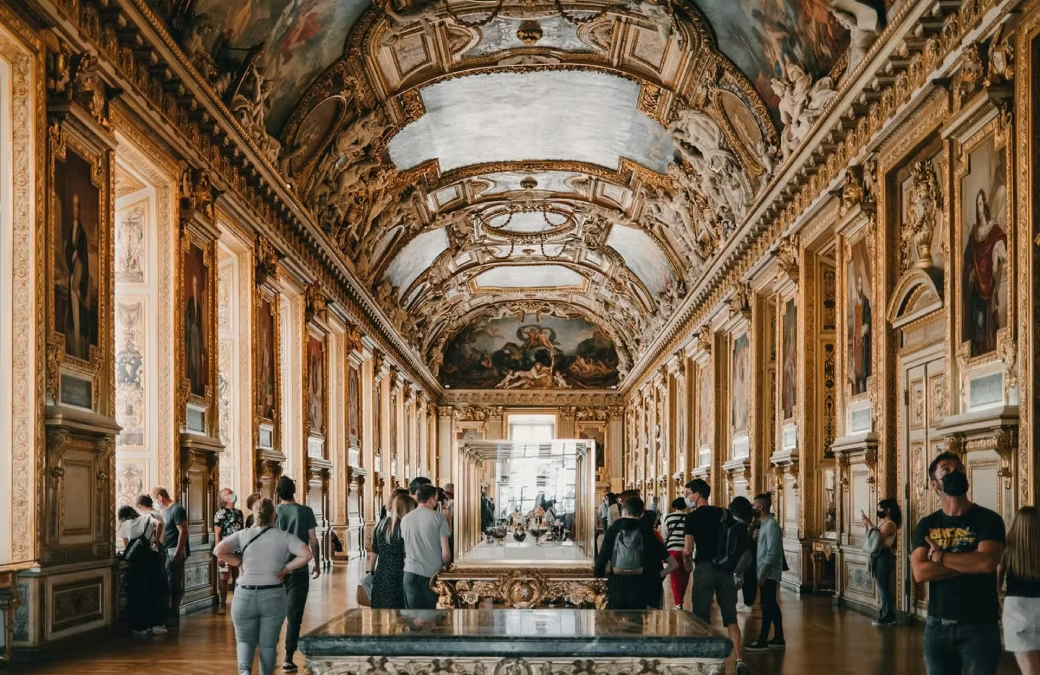
The Louvre’s Apollo Gallery (Galerie d’Apollon) has been closed to visitors since October 19, 2025, following a daring daylight theft of eight pieces of the French Crown Jewels valued at approximately €88 million. As of April 2026, the gallery remains closed with no reopening date announced. The remaining Crown Jewels — including the famous Regent, Sancy, and Hortensia diamonds — have been transferred to the Bank of France for safekeeping. The 17th-century gallery itself, a Baroque masterpiece by Charles Le Brun, is undergoing enhanced security upgrades before any potential reopening.
The Apollo Gallery is one of the most historically significant spaces in the Louvre — a 17th-century Baroque masterpiece that served as the prototype for Versailles’ Hall of Mirrors. For centuries it housed what remained of the French Crown Jewels, a collection assembled by kings from Francis I to Napoleon III. On October 19, 2025, thieves broke in during daylight hours and stole eight pieces worth approximately €88 million in under eight minutes. The gallery has been closed ever since.
This guide explains the current status of the gallery, the heist, what remains of the Crown Jewels, and what visitors to the Louvre should know about this specific part of the collection as of 2026.
Current Status (April 2026)
The Apollo Gallery is closed to visitors and has been since October 19, 2025. No reopening date has been announced.
The closure reflects:
- Ongoing security upgrades — the Louvre is implementing new surveillance systems, reinforced display cases, and additional physical barriers (including metal bars on the window used by the thieves)
- Transfer of remaining Crown Jewels — the surviving royal diamonds (Regent, Sancy, Hortensia) were moved to the Bank of France as a precaution
- Investigation continues — while arrests have been made, the eight stolen pieces have not been recovered
Official closure status is updated on the Louvre’s website. Check “List of open galleries” at louvre.fr before your visit if this gallery is a priority for you.
What the Apollo Gallery Is
The Galerie d’Apollon is a 61-metre-long gallery on the first floor of the Denon Wing’s southwestern corner (Room 705). It was built in 1661 under Louis XIV — the Sun King’s first major contribution to the Louvre Palace.
Architectural and historical significance
The gallery was designed by Louis Le Vau (architect of Versailles and the Louvre’s east facade) with interior decoration led by Charles Le Brun (who would go on to decorate Versailles’ Hall of Mirrors). The Apollo Gallery was, in effect, the first draft of the Hall of Mirrors — Le Brun developed his signature style of allegorical ceiling paintings, gold leaf, and integrated sculpture here before scaling it up at Versailles.
Key features:
- Ceiling paintings by Charles Le Brun and Eugène Delacroix, depicting the triumph of the sun god Apollo (a metaphor for Louis XIV himself)
- Allegorical sculpture and decorative mouldings
- Gold leaf, crystal, and marble throughout
- Tall windows overlooking the Seine, providing the natural light that illuminates the decoration
The gallery’s theme is consistent: Apollo as the sun god, chosen because Louis XIV styled himself as the “Sun King” (Roi Soleil). The ceiling fresco The Triumph of Apollo by Delacroix (added 1850–1851) is the dramatic centrepiece.
What was displayed before October 2025
The Apollo Gallery housed the surviving pieces of the French Crown Jewels — a collection that had been dramatically reduced over the centuries.
- 1793: Most of the Crown Jewels were stolen during the French Revolution. Some were recovered, but many were never seen again.
- 1887: Most of what remained was auctioned off by the French Third Republic — a controversial decision to fund the Republic’s budget by selling royal assets. Over 60,000 gems were sold.
- 20th century: The surviving pieces (what had been kept for “historical and artistic importance”) were displayed at the Louvre.
By 2025, the gallery contained about 23 pieces of royal jewellery — a small fraction of what had once existed but still one of the most important collections of royal regalia in the world.
The October 2025 Theft: The Known Facts
The morning of October 19, 2025
On a Sunday morning, shortly after the Louvre opened, four thieves arrived at the southern facade of the Denon Wing in a white truck equipped with a mechanical cherry picker (a vehicle-mounted platform lift, commonly used by Parisian movers).
The thieves wore reflective safety vests — deliberately chosen to blend in as construction workers at a building known for constant renovation and maintenance work.
The theft (estimated 7–8 minutes)
- Using the cherry picker, two of the thieves reached the first-floor window of the Apollo Gallery from outside
- They cut through the window with a disc cutter (angle grinder)
- Inside, they smashed two display cases with the same equipment
- Eight pieces were taken in approximately four minutes of actual time inside the museum
- Alarms activated, drawing Louvre security toward the gallery
- The thieves escaped by descending the cherry picker and fleeing on waiting motorbikes
What was stolen
Eight pieces, valued collectively at approximately €88 million:
- Empress Eugénie’s diamond and pearl diadem
- Empress Eugénie’s corsage-bow brooch (a reliquary brooch with over 1,300 diamonds)
- Empress Marie-Louise’s emerald necklace — a gift from Napoleon I to his second wife
- Empress Marie-Louise’s matching emerald earrings
- A reliquary brooch
- Additional pieces of royal jewellery
What the thieves dropped
While fleeing, the thieves dropped Empress Eugénie’s emerald-set imperial crown — a piece set with over 1,300 diamonds. The crown was damaged (the thieves had forced it through an opening too small for it), but recoverable. The Louvre has initiated a restoration process; in February 2026, the museum began a bidding process for a specialist restorer.
A second jewelled item was also dropped during the escape, though authorities have not publicly identified it.
What the thieves did not take
Despite their proximity, the thieves did NOT take the most famous and valuable individual diamonds in the gallery:
- The Regent Diamond (140.64 carats) — valued at approximately €51 million alone. One of the finest white diamonds ever discovered.
- The Sancy Diamond (55.23 carats) — a pale yellow diamond with legendary provenance through English and French royalty.
- The Hortensia Diamond (21.32 carats) — a pale pink diamond named for Napoleon’s stepdaughter.
Why these were spared: Experts believe the thieves specifically avoided these stones because they are too internationally documented to be sold. Every cut facet is photographed, recorded, and identifiable. Any attempt to sell any of these stones through any legitimate or black-market channel would trigger immediate identification.
The investigation
- Four arrests have been made as of the investigation’s active phase
- Nine additional suspects were detained and most released
- Charges filed against five individuals
- Eight stolen pieces remain missing as of April 2026
- Experts fear the pieces may have been dismantled — settings melted down, stones recut and sold anonymously
Interpol added the jewels to its Stolen Works of Art database on October 20, 2025.
The Crown Jewels That Remain
As of 2026, the remaining French Crown Jewels (including the famous diamonds) have been transferred to the Banque de France (Bank of France) for safekeeping. They are not currently on public display.
The Regent Diamond
Acquired by the Duke of Orléans (regent of France) in 1717 from a gem merchant who had bought it from a slave who had stolen it from an Indian mine. One of the finest colourless diamonds ever cut, weighing 140.64 carats. Historically set in the Crown of Louis XV and various ceremonial objects.
The Sancy Diamond
A pale yellow, 55.23-carat diamond with a provenance stretching back to the 16th century. Owned variously by Charles the Bold of Burgundy, Portuguese and English monarchs (including James I), and eventually the French crown. Named for Nicolas de Sancy, a 16th-century French nobleman who once owned it.
The Hortensia Diamond
A pale pink, 21.32-carat diamond. Named for Queen Hortense of Holland, Napoleon’s stepdaughter. Mounted in various royal jewellery pieces over the centuries.
The Coronation Crown of Louis XV
Created in 1722 for Louis XV’s coronation. Set with the Regent Diamond at its centre. One of the few surviving French coronation crowns — most others were destroyed during the Revolution.
When (and How) the Apollo Gallery May Reopen
The Louvre has not announced a reopening date. The key steps being taken:
Security upgrades
- New metal bars on windows (already installed as of December 2025)
- Enhanced CCTV coverage — previous security audit had noted that only 39% of the Louvre’s rooms were monitored by cameras, and the Apollo Gallery’s single exterior camera was facing the wrong direction
- Reinforced display cases with bulletproof glass
- Possible timed-entry requirements when the gallery does reopen (similar to the Mona Lisa room)
- Additional security staff deployed permanently in the gallery
Restoration work
- Empress Eugénie’s dropped crown is undergoing specialist restoration (bidding process began February 2026)
- The gallery itself is being inspected for any structural or decorative damage
Broader Louvre security overhaul
The October 2025 heist accelerated a broader security programme known as “Louvre New Renaissance” — a $933 million (approximately €850 million) long-term renovation and security upgrade plan. Between 2022 and 2025, 134 new digital cameras had been installed; the heist revealed further gaps. The museum’s director Laurence des Cars offered her resignation after the theft (it was declined by the Culture Minister), and appeared before the French Senate’s Culture Committee to answer questions about security failings.
Likely timeline
Based on similar high-profile security upgrades at other major museums, a realistic reopening window is late 2026 or 2027. The Louvre has not confirmed any timeline publicly.
What Visitors Can Do Instead
While the Apollo Gallery is closed, visitors interested in French royal history and decorative arts have several alternatives within the Louvre:
The Napoleon III Apartments
Where: Richelieu Wing, Level 1
The best alternative for visitors interested in French royal luxury. These state rooms from 1852–1861 (Second Empire) are fully open and provide an extraordinary view of 19th-century palace interiors. See Louvre Hidden Gems.
The Medieval Louvre (Royal Treasury Rooms)
Where: Richelieu Wing, Rooms 501–505
Contains Joyeuse, the coronation sword of French kings (used from the 13th century), and Napoleon’s Imperial Crown. Historically important royal objects remain on display here despite the Apollo Gallery closure.
The Decorative Arts Galleries
Where: Richelieu Wing, Level 1
Furniture, tapestries, porcelain, and decorative objects from the French royal collection spanning the 16th through 19th centuries. Many works were originally displayed in French royal residences.
The Grand Galleries of the Louvre Palace
The building itself was a French royal residence for over 400 years. Walking through the Denon Wing, the Richelieu Wing, and the courtyards provides a physical connection to the French monarchy.
Practical Information
Is the Louvre open?
Yes. The Louvre reopened October 22, 2025 — just three days after the heist. Only the Apollo Gallery is closed. All other galleries (including the Mona Lisa, Venus de Milo, Winged Victory, Egyptian antiquities, and the rest) are fully accessible.
Are tickets refundable if I specifically wanted to see the Apollo Gallery?
No. Louvre tickets give access to the full museum; there’s no separate “Apollo Gallery ticket.” Since the rest of the museum is open and a typical ticket covers 35,000+ works, standard refund policies apply. See Louvre Ticket Refunds, Changes & Cancellations.
Can I see any of the Crown Jewels elsewhere?
Not currently publicly. The remaining Crown Jewels are in storage at the Banque de France. No public display of any French Crown Jewels exists as of 2026.
Can I see the exterior of the Apollo Gallery?
The gallery’s exterior — overlooking the Seine on the Louvre’s southern facade — is visible from the riverfront. You can walk along the Quai François Mitterrand and see the windows (now with security bars installed in December 2025).
Is the heist covered in any Louvre tours?
Licensed guides will often discuss the October 2025 heist during Louvre tours, particularly those covering the Denon Wing. It’s now part of the museum’s history. The gallery itself is not accessible for tours.
Looking Ahead
The October 2025 heist was a genuine turning point for the Louvre. Beyond the material loss of the stolen pieces, it exposed vulnerabilities in the security of the world’s most visited museum. The Louvre’s response — significant security upgrades, the Apollo Gallery closure, the Bank of France transfer of remaining Crown Jewels — will shape the museum for years to come.
Whether the stolen pieces are ever recovered is uncertain. Experts estimate the probability declines with each passing month, as the settings are likely to have been melted down and the stones recut for anonymous sale. French investigators continue working, and the case remains active.
When the Apollo Gallery reopens, visitors will likely experience a very different space — more secure, possibly with timed entry like the Mona Lisa room, and with the absence of eight notable pieces documented in case text and historical photographs. It will remain one of the most architecturally beautiful spaces in the Louvre, and the ceiling paintings by Le Brun and Delacroix are entirely unaffected by the heist.
Frequently Asked Questions
Is the Apollo Gallery open in 2026?
No. The Apollo Gallery has been closed since October 19, 2025, following the theft of eight pieces of the French Crown Jewels. No reopening date has been announced as of April 2026.
What was stolen from the Apollo Gallery?
Eight pieces of French royal jewellery valued at approximately €88 million, including Empress Eugénie’s diamond and pearl diadem, her corsage-bow brooch, Empress Marie-Louise’s emerald necklace and earrings (a gift from Napoleon I), and additional royal pieces.
Have the stolen jewels been recovered?
No. As of April 2026, the eight stolen pieces have not been recovered. Four people have been arrested and charged in connection with the heist, but the jewels themselves remain missing. Experts fear they may have been dismantled — settings melted and stones recut for anonymous sale.
What happened to the Regent Diamond?
The Regent Diamond was not stolen. Despite being in the Apollo Gallery at the time of the heist and being the most valuable single stone at €51 million, the thieves deliberately avoided it because it’s too internationally documented to sell. After the heist, the Regent Diamond (along with the Sancy and Hortensia diamonds) was transferred to the Bank of France for safekeeping.
Can I still visit the rest of the Louvre?
Yes. The Louvre reopened on October 22, 2025 — just three days after the heist. Only the Apollo Gallery is closed. All other galleries including the Mona Lisa, Venus de Milo, Winged Victory, Egyptian antiquities, and all the Italian Renaissance paintings are fully accessible.
Is the Apollo Gallery damaged?
The gallery structure itself was not significantly damaged. The thieves broke a window (now repaired and reinforced with metal bars) and smashed two display cases. The 17th-century ceiling paintings by Charles Le Brun and Eugène Delacroix, the gold leaf decoration, and the marble floors are unaffected.
What security has been added?
Metal bars were installed on the Apollo Gallery window in December 2025. The Louvre is implementing broader security upgrades including enhanced CCTV coverage (previous audits had found only 39% of rooms monitored), reinforced display cases, and additional security personnel. The “Louvre New Renaissance” €850 million renovation plan has been accelerated.
Will the Apollo Gallery ever reopen?
Almost certainly yes — the gallery is architecturally one of the most important spaces in the Louvre. However, no reopening date has been announced. Based on similar projects at major museums, late 2026 or 2027 are realistic possibilities. When it reopens, expect more restrictive access and possibly timed entry.
Can I see any of the remaining French Crown Jewels?
Not currently publicly. The remaining Crown Jewels (including the Regent, Sancy, and Hortensia diamonds, plus the Coronation Crown of Louis XV) are in storage at the Banque de France. No public display exists as of April 2026.
Was Empress Eugénie’s crown destroyed?
No, but it was damaged. The thieves dropped it while fleeing (the opening in the glass case they made was too small for the crown, and forcing it through caused damage). It’s recoverable and undergoing specialist restoration — the Louvre began a bidding process for restorers in February 2026.
Who was arrested for the heist?
Four men have been arrested and charged — two primary suspects in their 30s from the Seine-Saint-Denis region of Paris, and additional accomplices. Nine additional people were detained and most released. The investigation continues; authorities have not ruled out additional arrests.
Should I book a Louvre visit based on the Apollo Gallery?
No. With the Apollo Gallery closed indefinitely, don’t plan your visit around it. The rest of the Louvre — including the three must-see masterpieces and thousands of other great works — remains fully accessible. If seeing the Apollo Gallery is specifically important to you, delay your visit until official reopening is announced.
How can I check if the Apollo Gallery has reopened?
Check the Louvre’s official website at louvre.fr — specifically the “List of open galleries” page which shows daily updates on which rooms are accessible. Media announcements will also accompany any reopening.
