

Venus de Milo at the Louvre: Complete Visitor Guide
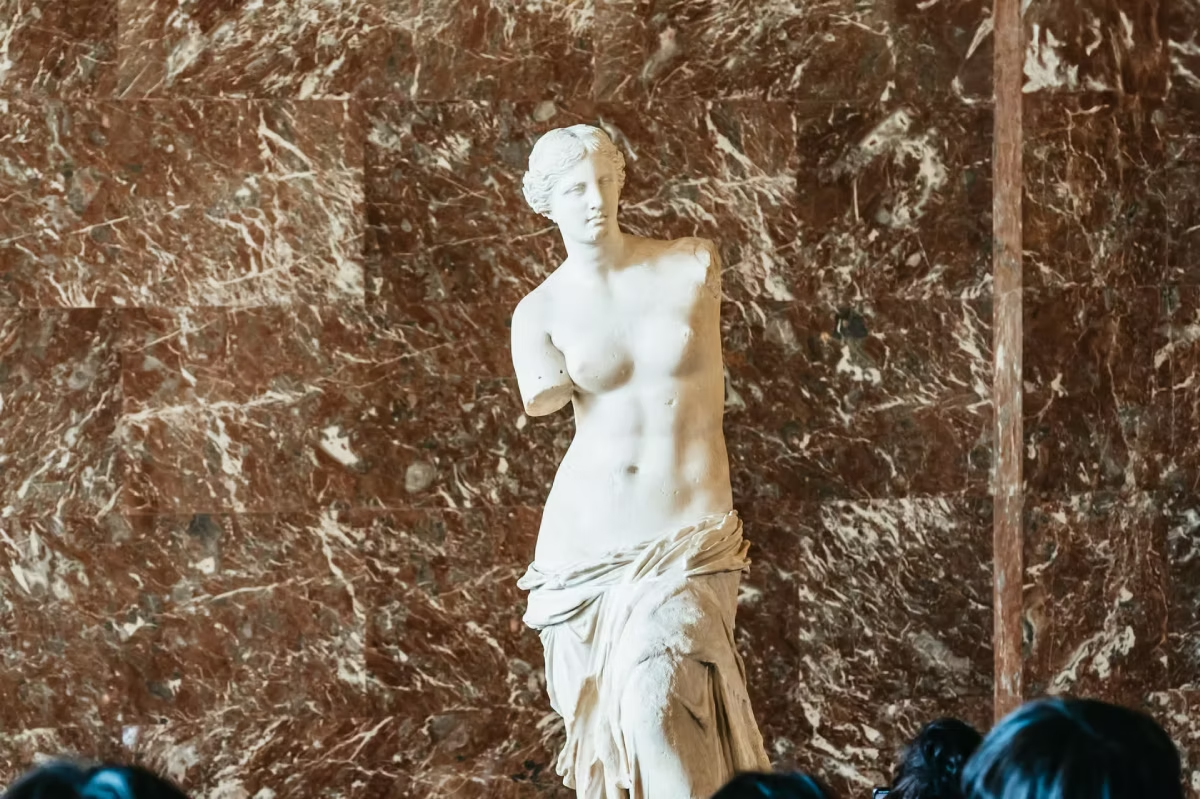
The Venus de Milo is displayed in Room 345 of the Sully Wing, Level 0, in the Galerie des Antiques. Carved in Parian marble around 150–125 BCE, she stands just over 2 metres tall and depicts Aphrodite, the Greek goddess of love. She was discovered in 1820 on the Greek island of Milos by a local farmer and acquired by France the same year. Her missing arms have never been found. She’s one of the Louvre’s “big three” masterpieces alongside the Mona Lisa and the Winged Victory of Samothrace.
She has no arms, no creator signature, and no certain date. Yet the Venus de Milo is one of the most recognisable sculptures ever made — a 2-metre marble goddess who has defined Western ideas of classical beauty for over two centuries. Unlike the Mona Lisa, she usually has no crowd at her feet. You can walk right up to her, circle her, and spend genuine uninterrupted time with one of the greatest surviving works of Greek sculpture.
This guide covers where to find her in the Louvre, the story of her discovery, the mysteries that still surround her, and what to look for when you visit.
Where the Venus de Milo Is Located
The Venus de Milo is displayed in Room 345, in the Sully Wing on Level 0 (ground floor). She stands in the Galerie des Antiques, at the end of a long corridor of Greek statuary.
How to navigate there
From the Pyramid entrance:
- Descend into the Napoleon Hall
- Head toward the Sully Wing (signs direct you to “Antiquités grecques, étrusques et romaines”)
- Take the steps up to Level 0 of the Sully Wing
- Follow the Galerie des Antiques through the Greek sculpture rooms
- The Venus de Milo is in Room 345, positioned at the gallery’s dramatic end
Walking time from the Pyramid: about 8–12 minutes.
What to look for
Unlike the Mona Lisa, she’s displayed as a freestanding sculpture rather than behind glass. You can walk a full 360 degrees around her and view her from every angle. The room has high ceilings and natural light filtering through the windows — the design deliberately emphasises her monumental presence.
Key Facts About the Venus de Milo
| Date | Approximately 150–125 BCE (Hellenistic period) |
| Height | 2.02 metres (6 ft 7 in) |
| Material | Parian marble (a fine white marble from the Greek island of Paros) |
| Subject | Aphrodite, Greek goddess of love (known as Venus in Roman mythology) |
| Discovered | April 8, 1820, on the island of Milos (Melos), Greece |
| Discovered by | Yorgos Kentrotas, a Greek farmer |
| Attributed to | Alexandros of Antioch (based on a now-lost plinth inscription) |
| Acquired by France | 1820, through the Marquis de Rivière, French ambassador to the Ottoman Empire |
| Presented to | Louis XVIII, who donated her to the Louvre in 1821 |
| Current location | Louvre Museum, Sully Wing, Level 0, Room 345 |
Why the Venus de Milo Is Famous
The perfect timing of her discovery
When the Venus de Milo arrived in Paris in 1821, France was emerging from the Napoleonic Wars and had just lost many of its looted antiquities, including the Venus de’ Medici — the most celebrated classical Venus of the time. The French government was desperate for a replacement masterpiece that would restore the Louvre’s position as Europe’s greatest museum. The timing was perfect. The French art establishment promoted her aggressively, declaring her superior to the Venus de’ Medici and other classical Venuses. Within a generation, she was one of the most famous sculptures in the world.
Hellenistic sophistication
The Venus de Milo dates from the Hellenistic period (roughly 323–31 BCE) — the era following Alexander the Great’s conquests, when Greek culture spread across the Mediterranean. Hellenistic sculpture is characterised by:
- Emotional expression — earlier Classical Greek sculpture prioritised calm idealism
- Contrapposto — weight shifted to one leg, creating a natural S-curve pose
- Drapery as a technical showcase — the lower half’s sliding robe demonstrates the sculptor’s virtuosity
- Monumentality — larger-than-life figures with dramatic presence
She combines the serene beauty of Classical Greek art with Hellenistic technical sophistication.
The mystery of her arms
No one knows exactly what her arms were doing. The most widely accepted theory is that she was holding an apple — a reference to the Judgment of Paris, where Aphrodite won a beauty contest by being awarded a golden apple by the Trojan prince Paris. A marble hand holding an apple was discovered alongside her in 1820 but was lost during transport to France.
Other theories:
- She was holding a mirror, admiring herself
- She was holding a shield, reflecting a distant image
- She was part of a larger group sculpture with a male figure (perhaps Ares, her lover)
No definitive evidence exists.
Her universal recognisability
The Venus de Milo has been reproduced, parodied, adapted, and referenced in countless contexts — from 19th-century cameos to modern cartoons. Her silhouette is so iconic that most people recognise her from outline alone.
The Story of Her Discovery
On April 8, 1820, Yorgos Kentrotas, a Greek farmer on the Aegean island of Milos, was digging near an ancient site when he uncovered a marble torso. Nearby fragments included the lower body, a severed left arm holding an apple, and parts of the base with inscriptions.
At the time, Milos was part of the Ottoman Empire, and Greek antiquities were treated as commodities to be sold to European collectors. The French ambassador to the Ottoman Empire, the Marquis de Rivière, was informed of the discovery and arranged to acquire the sculpture for France.
A competition ensued with Ottoman authorities and English collectors, but the French won — securing her for approximately 7,500 francs. She was shipped to Toulon and then to Paris, arriving in early 1821. The Marquis presented her to King Louis XVIII, who donated her to the Louvre in March 1821.
The missing fragments: The apple-holding hand and the inscribed plinth were separated from the statue during transport. The plinth supposedly bore the inscription “Alexandros, son of Menides, citizen of Antioch on the Meander, made this” — but this plinth has been lost since the 19th century. Some scholars argue the inscription was deliberately suppressed because it dated the sculpture to the later Hellenistic period, which would have undermined French claims that she was a pure Classical Greek masterpiece from the time of Phidias.
What to Look For
The face
Aphrodite has a serene, idealised face — characteristic of later Hellenistic sculpture that still drew on Classical Greek ideals of beauty. Her gaze is directed slightly downward, creating a contemplative expression rather than confrontational stare.
The body
The Venus de Milo’s proportions represent the ancient Greek idealised female form: an elongated torso, small breasts, broad hips, and a soft musculature. The contrapposto pose — her weight on her right leg, her left hip raised — creates an S-curve that feels natural and alive.
The drapery
The most technically impressive part of the sculpture. Her robe begins wrapped around her waist, then slides down to gather at her hips. The sculptor has captured the exact tension between fabric falling and being held — a notoriously difficult effect in stone. The weight of the drapery visually anchors the composition.
The missing arms — what they suggest
Look at her shoulders: the left one is raised slightly, as if reaching outward or upward. The right is more relaxed. This supports theories where her left hand held something (like an apple or a mirror) while her right arm rested or supported the drapery. The angles of her shoulder stumps, studied in minute detail by scholars, remain the best evidence for what she was doing.
The base
The current base is a modern reconstruction, as the original inscribed plinth was lost. Notice that her stance is slightly off-vertical — this was deliberate in the original design, adding to the sense of movement.
When to Visit Her
The Venus de Milo is one of the less crowded major masterpieces at the Louvre. Unlike the Mona Lisa (which has constant crowds), you can usually view her in relative peace.
Best times for a quiet viewing
- 9:00 AM opening: Almost empty. You can have her essentially to yourself for a few minutes.
- After 5:00 PM on Wednesdays and Fridays (late opening): Tour groups have cleared. Exceptional time for photos.
- Weekday afternoons (Mon, Wed, Thu, Fri) 3:00–5:00 PM: Calm enough for quality viewing.
Times that are busier
- 10:30 AM – 2:00 PM, any day: Moderate crowds but still manageable.
- Weekend mornings: Peak crowds in Room 345, though still less chaotic than the Mona Lisa room.
You almost never have to queue to see the Venus de Milo. On a quiet day, you can spend 10+ minutes with her without anyone else in the immediate area.
Why She’s Worth Seeing
You can actually see her properly
Unlike the Mona Lisa, the Venus de Milo isn’t behind glass. You can walk all the way around her. Natural light from the gallery windows falls on her marble surface, revealing subtle details that photographs can’t capture. The experience is genuinely intimate in a way that’s rare with world-famous artworks.
She represents the peak of Hellenistic sculpture
Very few original Greek Hellenistic sculptures survive — most of what we have are Roman marble copies of lost Greek bronzes. The Venus de Milo is an original Greek work in Parian marble, making her an irreplaceable artefact.
She’s part of the Louvre’s Greek sculpture collection
The Galerie des Antiques surrounding her contains dozens of other major Greek sculptures — the Borghese Gladiator, the Sleeping Hermaphrodite, the Diana of Gabii. Visiting the Venus de Milo gives you an excuse to explore one of the world’s best ancient sculpture galleries.
Nearby Highlights in the Sully Wing
While you’re in this part of the museum, don’t miss:
- The Borghese Gladiator (nearby in the Galerie des Antiques): a bronze original by Agasias of Ephesus, discovered in 1611 near Rome
- The Sleeping Hermaphrodite (nearby): a spectacular Hellenistic sculpture on a mattress designed by Bernini
- The Egyptian Antiquities (same wing, lower levels): the Seated Scribe, the Great Sphinx of Tanis. See Louvre Egyptian Antiquities.
- The Diana of Gabii (nearby): another major Greek sculpture.
Practical Tips for Visiting the Venus de Milo
Walk all the way around her. Most visitors only view her from the front. The back shows extraordinary detail in the drapery folds. The three-quarter angle from her left side is the most photogenic.
Look up at her face. She’s about 2 metres tall on a base, so standing directly in front you’re looking at her waist. Back up 2–3 metres for a proper view.
Visit the Hand of Victory (Room 703) on the same trip. The palm of the Winged Victory of Samothrace, discovered in 1950 and never reattached, is displayed near where she stands. Two “big three” works in two stops.
Take your time. Unlike the Mona Lisa, there’s no pressure to move on. Spend 10–15 minutes examining her from different angles.
Photograph her from the three-quarter left view. This was her original designed viewpoint at Milos — she was meant to be seen from her left side.
Combine with Egyptian Antiquities. The Sully Wing has the Louvre’s strongest Egyptian collection. A full Sully Wing visit (Venus + Egyptian antiquities + Mesopotamian collections) can fill 2 hours.
Use the wall labels but don’t over-rely on them. The Louvre’s labels are informative but dense. Spend 5 minutes with the sculpture before reading about her; your unmediated first impression is often the most memorable.
Common Questions About the Venus de Milo
“Are the arms really lost?”
Yes. The left arm holding the apple was documented at the time of discovery in 1820 but lost during transport to France. Periodic searches and underwater expeditions near Milos have never recovered them. It’s now generally accepted they’re permanently lost.
“Was she painted?”
Yes, most likely. Like most ancient Greek sculptures, she was originally painted in vivid colours — hair, eyes, skin, and drapery probably all had applied pigment. Traces of paint have been detected on some ancient sculptures but have worn away over 2,000+ years.
“Is she really from the classical Greek era?”
No. She dates from the Hellenistic period (roughly 150–125 BCE), which is several centuries after the Classical Greek era (480–323 BCE). Early French promoters tried to date her to the Classical era to enhance her prestige, but modern scholarship firmly places her in the Hellenistic period.
“Who made her?”
Most scholars attribute her to Alexandros of Antioch, based on the lost plinth inscription. He was a Hellenistic sculptor about whom little else is known.
“Why isn’t she called ‘Aphrodite’?”
In French, she’s often called “Aphrodite de Milos” — her Greek mythological name. “Venus de Milo” uses her Roman name (Venus) but her Greek geographical origin (Milos). This hybrid naming was standard in 19th-century Europe.
The Venus de Milo Through History
- c. 150–125 BCE: Carved in the Hellenistic period, likely by Alexandros of Antioch
- Ancient times: Stood somewhere on the island of Milos
- April 8, 1820: Discovered by Yorgos Kentrotas
- October 1820: Acquired by the Marquis de Rivière for France
- March 1821: Donated to the Louvre by Louis XVIII
- 1870–71: Hidden during the Franco-Prussian War
- 1939: Hidden again during World War II at Château de Valençay
- 1945: Returned to the Louvre
- Modern era: One of the Louvre’s three signature masterpieces, attracting an estimated 7 million viewers annually
FAQs About the Venus de Milo
Where is the Venus de Milo located in the Louvre?
The Venus de Milo is displayed in Room 345, in the Sully Wing, Level 0 (ground floor), in the Galerie des Antiques. From the Pyramid entrance, head to the Sully Wing and follow signs for Greek antiquities.
How tall is the Venus de Milo?
The Venus de Milo is 2.02 metres (6 feet 7 inches) tall. Made of Parian marble, a fine white marble from the Greek island of Paros. Her monumental scale is one of her most impressive features in person.
Who discovered the Venus de Milo?
A Greek farmer named Yorgos Kentrotas discovered her on April 8, 1820, on the island of Milos (Melos) in the Aegean Sea. She was partially buried near an ancient site. The French ambassador to the Ottoman Empire, the Marquis de Rivière, acquired her for France shortly after.
Why are the Venus de Milo’s arms missing?
Her arms were broken off at some point in antiquity and lost. The left arm, documented as holding an apple at the time of her 1820 discovery, was separated from the statue during transport to France and has never been recovered. Scholars theorise the arms depicted Aphrodite holding an apple (from the Judgment of Paris), a mirror, or supporting a shield — but no definitive evidence exists.
Who created the Venus de Milo?
Most scholars attribute her to Alexandros of Antioch, a Hellenistic Greek sculptor. This attribution is based on an inscription on the now-lost plinth. Almost nothing else is known about him.
How old is the Venus de Milo?
Approximately 2,150 years old. She dates from the Hellenistic period of ancient Greek sculpture, around 150–125 BCE.
Is the Venus de Milo the same as the Venus de’ Medici?
No. They’re separate sculptures. The Venus de’ Medici is a smaller Roman copy (1st century BCE) of a lost Greek original, and is displayed in the Uffizi Gallery in Florence. The Venus de Milo is an original Greek sculpture from the Hellenistic period.
Is the Venus de Milo behind glass?
No. Unlike the Mona Lisa, she’s displayed as a freestanding sculpture with no glass barrier. You can walk around her at normal gallery distance, though there are ropes and guards preventing direct contact.
Can I take photos of the Venus de Milo?
Yes, without flash. The lighting in Room 345 is natural and even, making photography relatively easy. The three-quarter view from her left side is the most photogenic angle.
What is the Venus de Milo made of?
She’s carved from Parian marble — a fine white marble quarried on the Greek island of Paros. Parian marble was highly prized in ancient Greek sculpture for its translucency and fine grain, which allowed detailed carving.
Is she heavy?
Yes. The sculpture weighs approximately 900 kilograms (2,000 pounds). Moving her requires specialised rigging and was a major logistical challenge during both World War evacuations.
Can I visit her for free?
Yes, if you qualify for Louvre free entry (under-18s, EEA residents under 26, disabled visitors + companion, etc.). See Louvre Free Entry Days: Who Qualifies.
