

Top 20 Must-See Artworks at the Louvre
The Louvre’s 20 must-see artworks span five millennia — from ancient Egyptian and Mesopotamian treasures to Italian Renaissance masterpieces and French Neoclassical paintings. The “big three” are the Mona Lisa (Denon Wing, Room 711), Venus de Milo (Sully Wing, Room 345), and Winged Victory of Samothrace (Denon Wing, Daru Staircase). Beyond these: Liberty Leading the People, The Raft of the Medusa, Veronese’s Wedding at Cana, four Leonardo paintings, the Great Sphinx of Tanis, the Code of Hammurabi, the Seated Scribe, and Michelangelo’s Slaves. Most can be covered in 3–4 hours with a planned route.
The Louvre has over 35,000 works on display. Seeing all of them would take weeks. But the 20 works on this list are the essential masterpieces — the works that make the Louvre the Louvre. They span the museum’s three great periods (ancient civilizations, Italian Renaissance, French 18th–19th century) and three great wings (Denon, Sully, Richelieu).
This guide ranks each work by significance, tells you exactly where to find it, and suggests an efficient route for covering all 20 in a single visit.
The Big Three — Start Here
1. Mona Lisa by Leonardo da Vinci
Where: Denon Wing, Level 1, Room 711 (Salle des États)
Date: c. 1503–1519
Why you must see her: The most famous painting in the world. Leonardo’s technical mastery of sfumato and her ambiguous expression are genuinely extraordinary — famous reputation deserved on merit. Expect crowds at all times.
See Mona Lisa at the Louvre for the complete guide.
2. Venus de Milo
Where: Sully Wing, Level 0, Room 345
Date: c. 150–125 BCE (Hellenistic Greek)
Why you must see her: One of the finest surviving ancient Greek sculptures and a defining image of classical beauty. Displayed without glass — you can walk around her.
See Venus de Milo at the Louvre for the complete guide.
3. Winged Victory of Samothrace
Where: Denon Wing, Level 1, Daru Staircase (Room 703)
Date: c. 190 BCE (Hellenistic Greek)
Why you must see her: Dramatically staged at the top of a monumental staircase, she’s the most theatrical sculpture display in any major museum.
See Winged Victory of Samothrace for the complete guide.
The French Masters
4. Liberty Leading the People by Eugène Delacroix
Where: Denon Wing, Level 1, Salle Mollien
Date: 1830
Why you must see it: Delacroix’s iconic revolutionary painting — Marianne (the personification of France) leading citizens over the barricades during the July Revolution of 1830. The prototype for every heroic national allegory since.
What to notice: The light falls dramatically on Marianne’s face and her raised flag. The dead body in the foreground grounds the heroism in reality. Look for the young boy with pistols — a direct influence on the character of Gavroche in Victor Hugo’s Les Misérables.
5. The Raft of the Medusa by Théodore Géricault
Where: Denon Wing, Level 1, Salle Mollien
Date: 1818–1819
Why you must see it: At 4.91 × 7.16 metres, an enormous canvas depicting the horrific real-life shipwreck of the French frigate Méduse in 1816. Survivors were left on a raft for 13 days — only 15 of 150 survived. Géricault visited morgues to study dead bodies while preparing the painting. One of the most harrowing works of Romantic art.
What to notice: The pyramidal composition — the eye flows up from the dead bodies to the living man waving a cloth. The figures grade from death to desperate hope. The storm-dark sky and churning sea.
6. The Coronation of Napoleon by Jacques-Louis David
Where: Denon Wing, Level 1, Salle Daru
Date: 1805–1807
Why you must see it: A vast 6.21 × 9.79-metre canvas depicting Napoleon crowning Empress Joséphine at Notre-Dame in 1804. David was the official Napoleonic painter; this is his most celebrated work. Over 150 figures, each carefully identified and politically chosen.
What to notice: Napoleon crowning himself is NOT shown — he’s about to crown Joséphine, who kneels. Pope Pius VII (who the royal family had expected would do the crowning) sits passively behind Napoleon. Napoleon’s mother, Letizia, is included in the painting despite not actually attending the ceremony.
7. The Oath of the Horatii by Jacques-Louis David
Where: Denon Wing, Level 1, Salle Daru
Date: 1784
Why you must see it: David’s revolutionary statement on civic virtue and classical heroism — three brothers swearing loyalty to Rome before battle. The painting defined Neoclassicism and influenced visual culture into the French Revolution. Crisp geometry, stoic men on the left, grieving women on the right.
8. The Lacemaker by Johannes Vermeer
Where: Richelieu Wing, Level 2
Date: c. 1669–1670
Why you must see it: One of only ~35 Vermeer paintings in existence. At just 24 × 21 cm, it’s the smallest Vermeer — a miniature masterpiece of concentration and light. A young woman leans forward at her lacemaking work, her needlework impossibly detailed.
What to notice: The unusual vertical composition. The white light falling on her forehead. The impossibly precise depiction of the fabric and thread.
The Italian Renaissance Beyond the Mona Lisa
9. The Wedding at Cana by Paolo Veronese
Where: Denon Wing, Level 1, Room 711 (Salle des États — opposite the Mona Lisa)
Date: 1562–1563
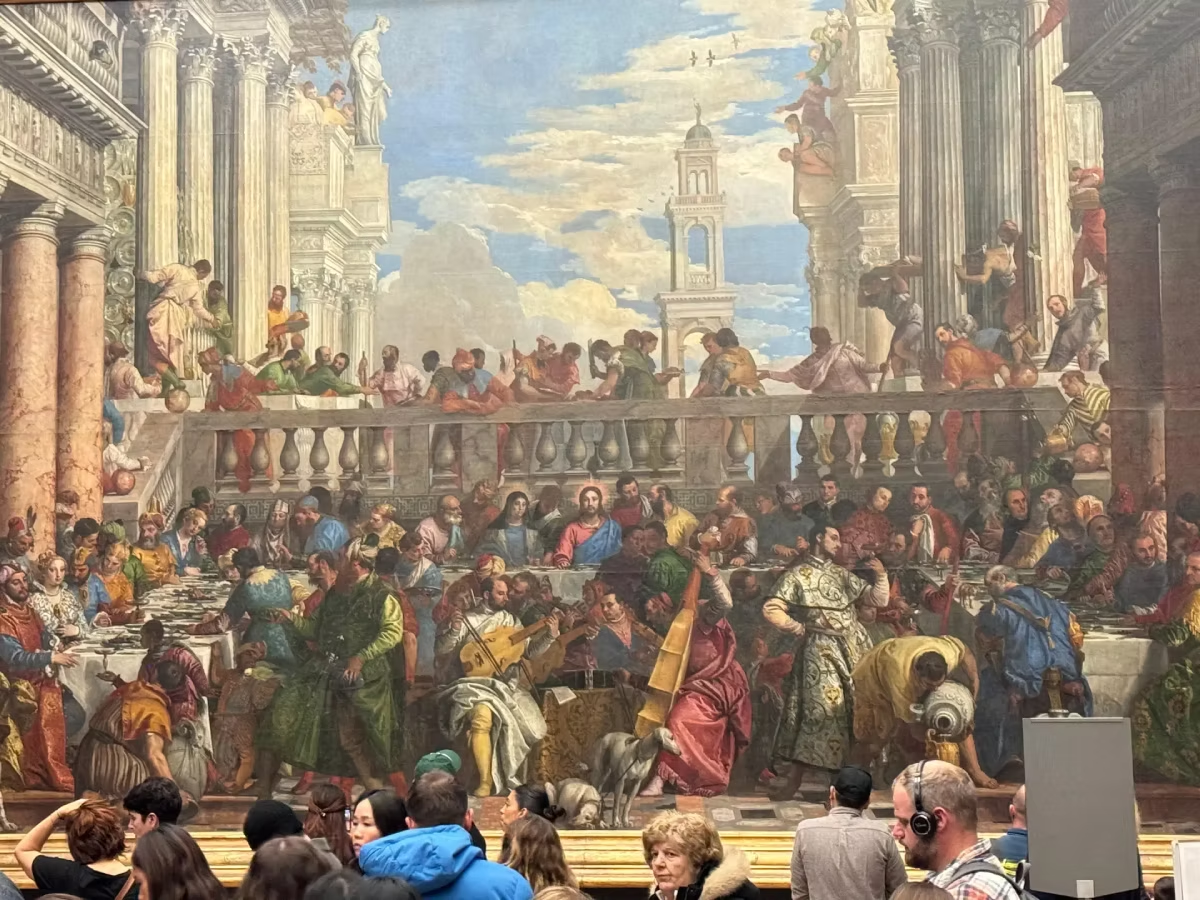
Why you must see it: At 6.77 × 9.94 metres, the largest painting in the Louvre. Most visitors face the Mona Lisa and miss the massive Veronese behind them. Over 130 figures in elaborate Venetian architecture. Napoleon’s troops took it from Venice in 1797.
What to notice: Christ at the centre — small, easy to miss. Titian and Veronese himself appear as musicians in the foreground. The architectural depth, the costumes, the 130+ individualised faces.
10. Virgin of the Rocks by Leonardo da Vinci
Where: Denon Wing, Level 1, Grande Galerie
Date: c. 1483–1486
Why you must see it: An earlier Leonardo masterpiece than the Mona Lisa. Dark, mysterious, with Leonardo’s signature sfumato and his fascination with geology. The Louvre’s version is considered the first — a later version is at the National Gallery London.
11. Saint John the Baptist by Leonardo da Vinci
Where: Denon Wing, Level 1, Grande Galerie
Date: c. 1513–1516
Why you must see it: Leonardo’s final known painting. All his signature techniques concentrated: sfumato, ambiguous expression, chiaroscuro. More unsettling than the Mona Lisa to many viewers.
12. The Virgin and Child with Saint Anne by Leonardo da Vinci
Where: Denon Wing, Level 1, Grande Galerie
Date: c. 1503–1519
Why you must see it: Unfinished painting showing three generations — Mary sitting in her mother Anne’s lap while holding the infant Christ. A masterpiece of composition that Leonardo worked on for 16 years.
For all four Leonardo paintings and other Italian Renaissance masterpieces, see Louvre Italian Renaissance Paintings.
The Ancient World
13. The Great Sphinx of Tanis
Where: Sully Wing, Egyptian Antiquities, Crypt of the Sphinx (entry to the department)
Date: Debated — possibly 4th Dynasty (26th century BCE) or 12th Dynasty
Why you must see it: One of the largest Egyptian sphinxes outside Egypt. 26 tonnes of pink granite with a lion’s body and pharaonic head. The atmospheric crypt installation is a highlight of the visit.
See Louvre Egyptian Antiquities for the full Egyptian tour.
14. The Seated Scribe
Where: Sully Wing, Egyptian Antiquities, Room 635, Level 1
Date: c. 2620–2500 BCE (Old Kingdom)
Why you must see him: The limestone statue’s eyes are inlaid with rock crystal, copper, and white magnesite — making him appear uncannily alive. His gaze seems to follow you around the display case. One of the most remarkable survivals from the ancient world.
15. The Code of Hammurabi
Where: Richelieu Wing, Mesopotamian Antiquities, Level 0
Date: c. 1754 BCE (Old Babylonian)
Why you must see it: A 2.25-metre black diorite stele inscribed with 282 laws from the Babylonian king Hammurabi — one of the earliest surviving legal codes in human history. The stele’s carved relief shows Hammurabi receiving the laws from Shamash, the Babylonian sun god.
What to notice: The Akkadian cuneiform script covering most of the stele. The detail of the carved scene at the top. The fact that this object is 3,800 years old and still legible — the legal code inscribed here influenced Jewish, Christian, and Islamic law.
16. The Winged Bulls of Khorsabad
Where: Richelieu Wing, Near Eastern Antiquities
Date: c. 713–706 BCE (Assyrian, reign of Sargon II)
Why you must see them: Colossal winged bull-human hybrid statues (lamassu) that originally guarded the entrance to King Sargon II’s palace at Khorsabad in Mesopotamia. Each is about 4.4 metres tall and weighs approximately 30 tonnes. They have the body of a bull, the wings of an eagle, and a bearded human head. Five legs (visible from different angles) create the illusion that they stand still when viewed from the front and walk when viewed from the side.
17. The Borghese Gladiator
Where: Sully Wing, Level 0, Galerie des Antiques
Date: c. 100 BCE
Why you must see it: A dynamic marble sculpture of a warrior in combat by Agasias of Ephesus — one of the few ancient Greek sculptures with a verified artist signature. Caught mid-action, shield raised against an unseen opponent.
See Louvre Greek & Roman Antiquities for more.
French Sculpture and Decorative Arts
18. The Dying Slave and Rebellious Slave by Michelangelo
Where: Denon Wing, Level 0, Italian sculpture gallery
Date: 1513–1515
Why you must see them: Two marble sculptures by Michelangelo, originally intended for the tomb of Pope Julius II. Unfinished, but this is their power — you can see the figures emerging from the marble, embodying Michelangelo’s famous conception of sculpture as “liberating” the figure trapped inside the stone.
What to notice: Compare the two — the Dying Slave is serene, accepting; the Rebellious Slave is contorted, fighting. Together they represent death and resistance.
19. Psyche Revived by Cupid’s Kiss by Antonio Canova
Where: Denon Wing, Level 0, Italian sculpture gallery
Date: 1787–1793
Why you must see it: Canova’s Neoclassical masterpiece — the mythological reunion of Cupid and Psyche captured in an impossibly tender embrace. The two figures form an X-shape of intertwined limbs and wings. One of the most technically accomplished sculptures ever made.
What to notice: The translucency of the marble. The way Canova makes stone look like skin. Walk around it — each angle reveals different aspects of the composition.
20. The Napoleon III Apartments
Where: Richelieu Wing, Level 1
Date: 1852–1861
Why you must see them: Not a single artwork but a suite of fully preserved state rooms from the Second Empire. Extraordinary opulence: red velvet, gold leaf, crystal chandeliers, ceiling frescoes. The Grand Salon is one of the most richly decorated rooms in Paris. Largely overlooked because they’re away from the main masterpieces, they’re the best surviving example of Second Empire palatial interior design.
What to notice: The scale of the Grand Salon. The dining room. The sense of stepping into mid-19th-century French aristocratic life.
An Efficient Route for All 20
A realistic single-visit route covering these 20 works takes about 3–4 hours of focused viewing, plus walking time.
Hour 1: Denon Wing Level 1 — the greatest hits
- Enter via the Pyramid
- Climb the Daru Staircase — Winged Victory of Samothrace (#3)
- Turn right into the Salon Carré
- Grande Galerie — Virgin of the Rocks (#10), Saint John the Baptist (#11), Virgin and Child with Saint Anne (#12)
- Salle des États — Mona Lisa (#1) + Wedding at Cana (#9)
- Salle Mollien — Liberty Leading the People (#4), The Raft of the Medusa (#5)
- Salle Daru — Coronation of Napoleon (#6), Oath of the Horatii (#7)
Hour 2: Denon Wing Level 0 — Italian sculpture
- Descend to Level 0
- Michelangelo’s Slaves (#18)
- Psyche Revived by Cupid’s Kiss (#19)
Hour 3: Sully Wing — Ancient Greek + Egyptian
- Walk to the Sully Wing
- Borghese Gladiator (#17)
- Venus de Milo (#2)
- Egyptian Antiquities — Great Sphinx of Tanis (#13)
- Level 1 Egyptian — Seated Scribe (#14)
Hour 4: Richelieu Wing — Mesopotamian + Vermeer + State rooms
- Walk to the Richelieu Wing
- Near Eastern Antiquities — Code of Hammurabi (#15)
- Winged Bulls of Khorsabad (#16)
- Level 2 — The Lacemaker (#8)
- Level 1 — Napoleon III Apartments (#20)
Essential Tips for Doing All 20 in One Visit
Start at 9:00 AM opening. This is non-negotiable. The Mona Lisa room fills fast; being there in the first 30 minutes makes a dramatic difference.
Do the Mona Lisa first, not last. Counterintuitive but correct — she’s the most crowded work. Getting her done early means you’re not fighting crowds late in the day.
Wear comfortable shoes. You’ll walk 6–8 km across the visit.
Carry water and snacks. There are cafés, but stopping to eat costs 20–30 minutes each time. A small bag with water and light snacks keeps you moving.
Download the Louvre app. Free. Has maps, audio tours, and helps with navigation when you get disoriented.
Don’t try to read every wall label. For must-see works, read the label; for everything else, just look.
Take a 10-minute rest every 90 minutes. Museum fatigue is real. Sit on a bench; let your feet rest.
Skip the Richelieu Wing if you’re tight on time. If you only have 2–3 hours, cut items #16–20 and focus on the Denon + Sully wings where the “big three” and most famous paintings live.
Late opening Wednesday/Friday for a second visit. If you have more than one day, do the big-ticket items on your first day, then use a late Wednesday or Friday evening (until 9:45 PM) to see lesser-crowded works like the Napoleon III Apartments or Vermeer’s Lacemaker in peace.
What Should Be on This List But Isn’t
Some absolutely worthy works didn’t make the top 20 for reasons of space. If you have time, consider adding:
- Apollo Gallery + French Crown Jewels — currently closed (see Apollo Gallery: What to Know in 2026)
- The Mastaba of Akhethotep — reconstructed Egyptian tomb chapel
- The Sleeping Hermaphrodite — with Bernini’s marble “mattress”
- Fra Angelico’s Coronation of the Virgin
- Raphael’s Castiglione portrait
- Caravaggio’s Death of the Virgin
- Vermeer’s Astronomer (also in the Louvre)
- The Syrian stele of Mesha
- Cycladic figurines (Sully Level -1)
These are covered in Louvre Hidden Gems: Off-the-Beaten-Path Masterpieces.
Frequently Asked Questions
What are the must-see artworks at the Louvre?
The “big three” are the Mona Lisa, Venus de Milo, and Winged Victory of Samothrace. Beyond those, the essential works include Liberty Leading the People, The Raft of the Medusa, Veronese’s Wedding at Cana, Leonardo’s three other paintings (Virgin of the Rocks, Saint John the Baptist, Virgin and Child with Saint Anne), Michelangelo’s Slaves, Canova’s Psyche, the Great Sphinx of Tanis, the Seated Scribe, the Code of Hammurabi, and Vermeer’s Lacemaker.
How many artworks are on display at the Louvre?
Approximately 35,000 works are on display at any time, out of a total collection of over 500,000 pieces. The rest are in storage, on loan, or undergoing restoration.
How long do I need to see the top 20?
Approximately 3–4 hours of focused viewing plus walking time. A full visit covering all 20 major works realistically takes 4–5 hours including breaks.
Is it possible to see the top 20 in one day?
Yes, with early arrival, a planned route, and disciplined pacing. Most first-time visitors do exactly this. See Louvre in One Day: Realistic Itinerary for a detailed timed plan.
What’s the most underrated must-see work?
Several candidates, but the Napoleon III Apartments are arguably the most underrated — most visitors never enter them, but they’re a breathtaking glimpse into Second Empire French opulence.
Can I see the top 20 with a guided tour?
Most guided tours cover 8–12 of the 20 in a typical 2.5–3 hour visit. For the full 20, you’d likely want to combine a guided tour for the Denon Wing highlights with independent exploration of the Sully and Richelieu Wings afterward. See Best Louvre Tour for Your Visit.
Which of the must-see works is closed right now?
As of April 2026, the Apollo Gallery remains closed following the October 2025 theft of French Crown Jewels. The remaining jewels (including the Regent Diamond) have been transferred to the Bank of France for safekeeping. No reopening date has been announced.
What’s the smallest must-see work?
Vermeer’s The Lacemaker at 24 × 21 cm — smaller than the Mona Lisa.
What’s the largest must-see work?
Veronese’s Wedding at Cana at 6.77 × 9.94 metres — the largest painting in the Louvre’s collection.
Which wing has the most must-see works?
The Denon Wing — home to the Mona Lisa, Winged Victory, Italian Renaissance paintings, French Romantic paintings, and Michelangelo’s sculptures. Most first-time visitors spend 60–70% of their time here.
Are the must-see works in any particular order?
The order in this list reflects general fame and significance. The “big three” — Mona Lisa, Venus de Milo, Winged Victory — are universally considered the top tier. Rankings for the remaining 17 are subjective and contested among art historians.
Can I see the must-see works for free?
Yes, if you qualify for Louvre free entry (under-18, EEA resident under 26, disabled visitor + companion). See Louvre Free Entry Days. Otherwise, any standard Louvre ticket includes access to all permanent collection galleries where these works are displayed.
