

Louvre Egyptian Antiquities: Complete Visitor Guide
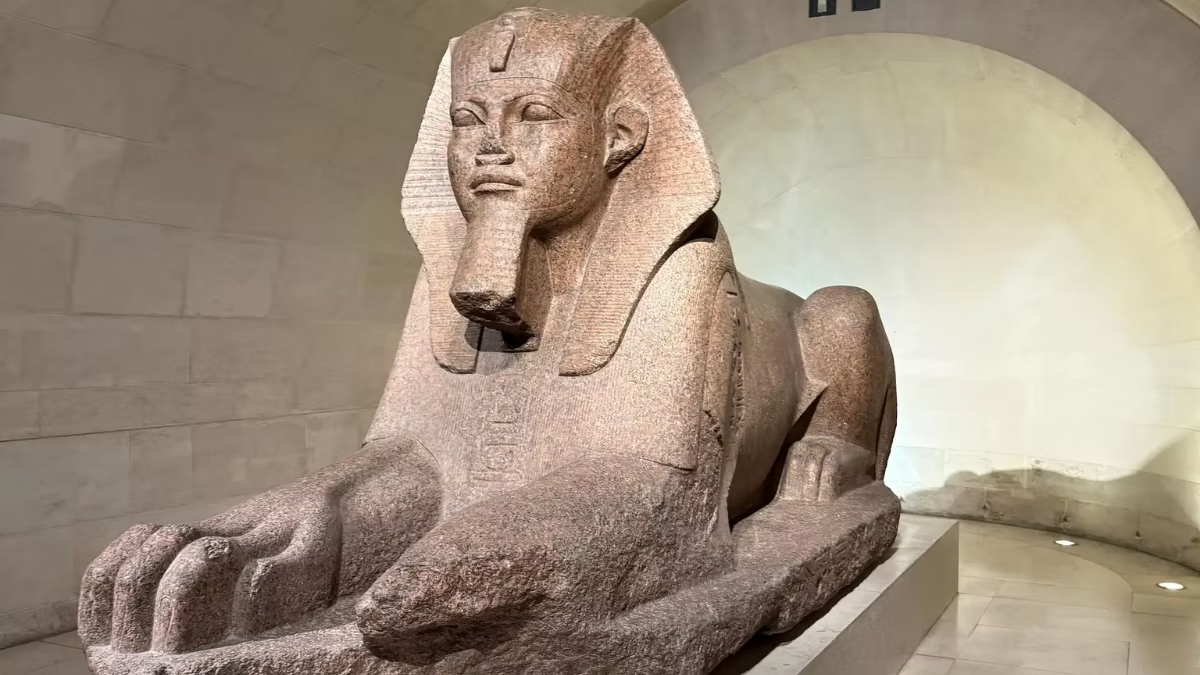
The Louvre’s Egyptian Antiquities collection contains over 50,000 objects spanning nearly 5,000 years of ancient Egyptian civilisation. It’s displayed across two levels of the Sully Wing. Level 0 focuses on daily life, religion, funerary practices, and monumental architecture (including the Great Sphinx of Tanis in the Crypt of the Sphinx). Level 1 provides a chronological artistic overview featuring the Seated Scribe, statues of pharaohs including Sesostris III and Ramesses II, and the Amarna-period masterpieces of Nefertiti and Akhenaten. Allow 90 minutes to 2 hours.
The Louvre has one of the greatest collections of ancient Egyptian art outside Egypt itself — over 50,000 objects across 20 rooms spanning almost 5,000 years of civilisation. Most visitors barely visit, hurrying to the Mona Lisa. That’s a mistake. The Egyptian galleries contain some of the most remarkable survivors of the ancient world: the Seated Scribe with his eerily alive crystal-inlaid eyes, the Great Sphinx of Tanis guarding the crypt entrance, and royal statues of pharaohs who ruled before Rome existed.
This guide covers the must-see Egyptian masterpieces, the room-by-room layout, and how to plan a focused visit that doesn’t get lost in the scale of the collection.
Where the Egyptian Antiquities Are Located
The Department of Egyptian Antiquities occupies two floors of the Sully Wing:
- Level 0 (ground floor): Rooms 321–338 — thematic displays on daily life, religion, funerary practices, monumental architecture
- Level 1 (first floor): Rooms 630–643 — chronological overview of almost 5,000 years of Egyptian art
- Lower level (Crypt of the Sphinx): Entry to the Egyptian collection, home to the Great Sphinx of Tanis
How to navigate there
From the Pyramid entrance:
- Descend into the Napoleon Hall
- Head toward the Sully Wing (signs direct you to “Antiquités égyptiennes”)
- The first stop is the Crypt of the Sphinx — you enter through a dramatic stone passage
- From the Crypt, stairs lead up to Level 0 (daily life and religion displays)
- Another staircase leads to Level 1 (chronological art history displays)
Walking time from the Pyramid: 5–7 minutes to the Crypt entrance.
The collection layout
The two levels are designed to be visited in sequence, but many visitors explore them independently. A full visit moves:
- Crypt of the Sphinx (dramatic introduction)
- Level 0 thematic rooms (how the Egyptians lived and died)
- Level 1 chronological rooms (how their art evolved)
Must-See Works in the Egyptian Collection
The Great Sphinx of Tanis
Where: The Crypt of the Sphinx, ground level entrance to the Egyptian Antiquities department
What it is: A colossal pink granite sphinx — lion’s body, human (pharaonic) head — measuring 183 cm tall, 154 cm wide, and 480 cm long. It weighs approximately 26 tonnes.
History: Discovered in 1825 in the ruins of the Temple of Amun-Ra at Tanis (capital of Egypt’s 21st and 22nd dynasties). Its exact date is debated — hypotheses range from the 4th Dynasty (26th century BCE) to the 12th Dynasty. The sphinx was “re-inscribed” by multiple later pharaohs (Amenemhat II, Merneptah, Shoshenq I), each claiming it as their own.
Why it’s special: One of the largest Egyptian sphinxes outside Egypt. The lion’s body symbolised the sun god Ra; the pharaonic head represented the link between kingship and the divine. It was acquired by the Louvre in 1826 as part of Henry Salt’s Egyptian collection, with the purchase led by Jean-François Champollion (decipherer of the Rosetta Stone).
What to notice: The inscription marks on the flanks, the extended paws in a protective pose, and the way the sculpture fills the crypt space. The dark setting of the crypt deliberately mimics Egyptian tomb architecture.
The Seated Scribe
Where: Room 635, Sully Wing, Level 1
What it is: A painted limestone statue (53.7 cm tall) of a seated male scribe with papyrus unrolled on his lap, pen poised. Dates to approximately 2620–2500 BCE (4th or 5th Dynasty).
Why it’s special: The most celebrated individual work in the Egyptian collection. His eyes — inlaid with rock crystal, red-veined white magnesite, and polished copper — make him appear preternaturally alive. The gaze seems to follow the viewer around the display case, creating one of the most uncanny experiences in the museum.
What to notice: Look at the eyes from different angles. The detail of the hand holding the pen. The painted skin colour (reddish-brown, characteristic of male figures in Egyptian art). The rolled papyrus across his lap — he’s literally mid-writing.
Who he was: The exceptional quality indicates a high-status dignitary, though his exact identity is lost. He would have been an educated administrator — ancient Egypt’s bureaucratic backbone.
Statues of Pharaohs and Queens
Where: Various rooms on Level 1
Key figures represented:
- Sesostris III (Middle Kingdom, ~1850 BCE) — known for expressive, world-weary facial features
- Hatshepsut (New Kingdom, ~1479–1458 BCE) — female pharaoh who ruled Egypt as king
- Amenophis III (New Kingdom, ~1386–1349 BCE) — father of Akhenaten
- Akhenaten (~1353–1336 BCE) — the “heretic pharaoh” who introduced monotheism
- Nefertiti — wife of Akhenaten (the Louvre holds a small head of her, though the famous bust is in Berlin)
- Ramesses II (~1279–1213 BCE) — the most powerful pharaoh, featured in multiple works
What to notice: Each period had distinct artistic conventions. Old Kingdom statues are formal and idealised. Middle Kingdom adds psychological depth. Amarna-period work (Akhenaten’s era) is unnervingly naturalistic with elongated faces. New Kingdom returns to grandeur.
Sekhmet Statues (The Temple Room)
Where: Room 324, Sully Wing, Level 0
What it is: A room filled with black granite statues of Sekhmet, the Egyptian lioness goddess of war and healing. Each statue is roughly life-sized, creating the effect of being surrounded by the goddess.
Why it’s special: Originally, there were 700+ Sekhmet statues lining the temple of Amenhotep III in Luxor (one for each day of the year, x2 for morning and evening rituals). Various museums now share portions of this enormous original commission. The Louvre’s statues give a sense of the scale.
What to notice: The subtle variations between statues — each was individually carved, though from a standard template. The dark granite against the gallery lighting creates a powerful atmosphere.
The Mastaba of Akhethotep
Where: Part of the Level 0 thematic displays
What it is: A reconstructed section of an Old Kingdom tomb chapel (mastaba) from Saqqara, dating to the 5th Dynasty (~2400 BCE). The walls are covered with reliefs of offerings, agricultural scenes, and hunting.
Why it’s special: It’s one of the few examples of Egyptian tomb architecture actually installed inside a Western museum. Walking into it is as close as most visitors get to entering an Egyptian tomb.
What to notice: The hierarchical scaling (important figures are larger), the left-to-right reading order of the scenes, and the incredibly detailed depictions of daily life — beer brewing, fishing, harvesting — which the Egyptians believed would magically sustain the deceased in the afterlife.
The Temple Hieroglyphs
Where: Early rooms on Level 0
Extensive displays of hieroglyphic inscriptions with explanations of how Champollion deciphered the script using the Rosetta Stone (which itself is in the British Museum). The Louvre’s hieroglyph room is one of the best places in any museum to understand how Egyptian writing actually works.
Jewellery and Everyday Objects
Where: Level 0 thematic rooms
The Louvre holds extraordinary collections of Egyptian jewellery — gold, lapis lazuli, carnelian, faience. Royal jewellery from Middle Kingdom tombs, funeral amulets, scarabs, and personal ornaments. These smaller objects often get overlooked but reveal the extraordinary craftsmanship of Egyptian artisans.
Coffins and Sarcophagi
Where: The funerary practices rooms on Level 0
A stunning collection of painted wooden coffins, stone sarcophagi, and mummification equipment. Includes the sarcophagus of Ramesses III (New Kingdom) and several complete nested coffins from the Third Intermediate Period.
The Book of the Dead Papyrus
Where: Level 1
Several illustrated papyri from the Book of the Dead — ancient Egyptian funeral texts containing spells to guide the soul through the afterlife. The Louvre’s copies are among the best-preserved examples anywhere.
Room-by-Room Layout
Level 0 (ground floor): Themes
- Rooms 321–323: Introduction to the Nile, mastaba tomb of Akhethotep, daily life
- Room 324: The Temple Room (Sekhmet statues)
- Rooms 325–327: Hieroglyphs and writing
- Rooms 328–331: Jewellery, everyday objects, domestic life
- Rooms 332–337: Religion, funerary practices, sarcophagi
Level 1 (first floor): Chronological art history
- Rooms 630–633: Old Kingdom (~2700–2200 BCE) — including the Seated Scribe
- Rooms 634–635: First Intermediate & Middle Kingdom (~2050–1700 BCE)
- Rooms 636–638: New Kingdom (~1550–1070 BCE)
- Rooms 639–641: Third Intermediate & Late Period (~1070–332 BCE)
- Rooms 642–643: Greco-Roman Egypt (332 BCE – 395 CE)
Suggested Visit Itineraries
Quick visit (45 minutes)
If time is tight:
- Great Sphinx of Tanis (Crypt of the Sphinx) — 5 minutes
- Mastaba of Akhethotep (Level 0) — 10 minutes
- Sekhmet Temple Room (Room 324) — 5 minutes
- Seated Scribe (Room 635) — 10 minutes
- Pharaoh statues (Level 1) — 15 minutes
Standard visit (90 minutes – 2 hours)
Full tour of must-sees plus Level 0 thematic rooms (daily life, religion, jewellery).
Deep-dive visit (3+ hours)
Complete coverage including the Book of the Dead papyri, Greco-Roman Egypt gallery, hieroglyphs room, and the lesser-visited Middle Kingdom and Third Intermediate Period rooms. Combine with the adjacent Near Eastern Antiquities department for a full ancient civilizations day.
When to Visit
The Egyptian galleries are among the less crowded parts of the Louvre. Unlike the Denon Wing (Mona Lisa, Italian paintings), you can usually explore in relative peace.
- 9:00 AM opening: Almost empty. You can have the Seated Scribe to yourself.
- Late afternoons (3:00 PM onwards): Calm, with natural light in the Level 0 rooms.
- Wednesday and Friday evenings (after 6:00 PM during late opening): Excellent — the Sphinx crypt is particularly atmospheric at night.
- Weekend mornings: Moderate crowds but still manageable.
Practical Tips
Start with the Crypt of the Sphinx. The architectural drama of entering the Egyptian collection through the Crypt sets the mood correctly. Don’t bypass it for a side entrance.
Don’t try to see everything. 50,000 objects is overwhelming. Pick 5–10 must-sees and spend quality time with them.
Sit on the benches in Room 635. Spend real time with the Seated Scribe. His eyes genuinely do seem to follow you.
Look at the walls as much as the cases. Many rooms have painted tomb reliefs and wall fragments that visitors walk past without noticing.
Use the Louvre’s free app for audio tours. The Egyptian collection has excellent audio segments explaining specific objects.
Combine with Near Eastern Antiquities. The Louvre’s Mesopotamian and Persian collections are in adjacent rooms and are similarly world-class.
Check if specific rooms are open. Renovations periodically close specific rooms or cases. The Louvre’s website has the most current status.
Bring reading glasses if you need them. The wall labels contain detailed information that’s essential for context — most labels are quite small.
Context: Why the Louvre Has So Much Egyptian Art
The Louvre’s Egyptian collection began in 1826, when Jean-François Champollion convinced King Charles X to establish a dedicated Egyptian Antiquities department. Champollion — the scholar who had deciphered hieroglyphs in 1822 using the Rosetta Stone — became the first curator. He purchased three major collections at once, including Henry Salt’s second collection (which contained the Great Sphinx of Tanis).
The collection grew dramatically in the mid-19th century when French archaeologist Auguste Mariette excavated at Saqqara in 1852–1853. Under the era’s agreement between Egypt and European archaeologists, Egypt shared a portion of the finds — Mariette sent nearly 6,000 objects to the Louvre, including the Seated Scribe.
Today, the collection includes objects acquired through purchases, gifts, and scientific missions. Modern repatriation conversations continue around some objects, though the Louvre maintains it acquired the collection legally under the laws of the period.
FAQs About Louvre Egyptian Antiquities
Where are the Egyptian antiquities in the Louvre?
The Department of Egyptian Antiquities occupies two floors of the Sully Wing — Level 0 (ground floor) for thematic displays on daily life and religion, and Level 1 (first floor) for a chronological art history overview. The entrance is through the Crypt of the Sphinx, at the lower level.
How big is the Louvre’s Egyptian collection?
Over 50,000 objects across 20+ rooms. It’s one of the largest and most important collections of ancient Egyptian art outside Egypt. Spans nearly 5,000 years of history, from Predynastic Egypt to Greco-Roman Egypt.
Where is the Great Sphinx of Tanis?
In the Crypt of the Sphinx, the dramatic entrance room to the Egyptian Antiquities department in the Sully Wing. It sits in the centre of the crypt, visible from multiple angles.
Where is the Seated Scribe?
In Room 635, Sully Wing, Level 1 (first floor). The Scribe is displayed in a glass case with lighting designed to emphasise his rock-crystal inlaid eyes.
How long do I need for the Egyptian galleries?
For must-sees only, 45–60 minutes. For a proper visit covering both floors, 90 minutes to 2 hours. For a deep exploration including lesser-visited rooms, 3+ hours.
Are there mummies in the Louvre’s Egyptian collection?
Yes, though mummies are displayed more discreetly than in some museums. The Louvre holds several human mummies and animal mummies (including cats and ibis), along with an extensive collection of funerary objects.
What’s the oldest object in the Louvre’s Egyptian collection?
Objects from the Predynastic period (~4000–3150 BCE) are the oldest — pre-dating the First Dynasty. These include painted pottery, flint tools, and early ritual objects. They’re displayed in the Level 0 rooms at the start of the chronological tour.
Was the Louvre’s Egyptian collection looted?
The collection came through various 19th-century routes: legal purchases (like the Henry Salt collection), archaeological excavations under share agreements with Egypt, and diplomatic gifts. Modern standards would consider some of these acquisitions ethically questionable. The Louvre engages with ongoing repatriation discussions but maintains the collection was legally acquired under the laws of the period.
Can I take photos in the Egyptian galleries?
Yes, without flash. The dim lighting in some rooms (especially the funerary and sarcophagus rooms) makes photography challenging but not impossible. Modern phone cameras handle low light well.
Is the Egyptian collection child-friendly?
Very. Children are often captivated by the Sphinx, the Seated Scribe’s eyes, the mummies, and the colourful wall paintings. The Louvre Family Tour for Kids often includes the Egyptian collection because it’s visually dramatic and narrative-rich.
What’s the connection between the Louvre and the Rosetta Stone?
The Rosetta Stone itself is at the British Museum in London, not the Louvre. However, Jean-François Champollion — the French scholar who deciphered hieroglyphs in 1822 using the Rosetta Stone’s trilingual inscription — became the first curator of the Louvre’s Egyptian department in 1826. His legacy shapes the collection.
Can I visit the Egyptian collection for free?
If you qualify for Louvre free entry (under-18, EEA resident under 26, disabled visitor + companion). See Louvre Free Entry Days. Otherwise, your standard Louvre ticket includes the Egyptian galleries.
