

Louvre Accessibility: Wheelchairs, Strollers & Lifts
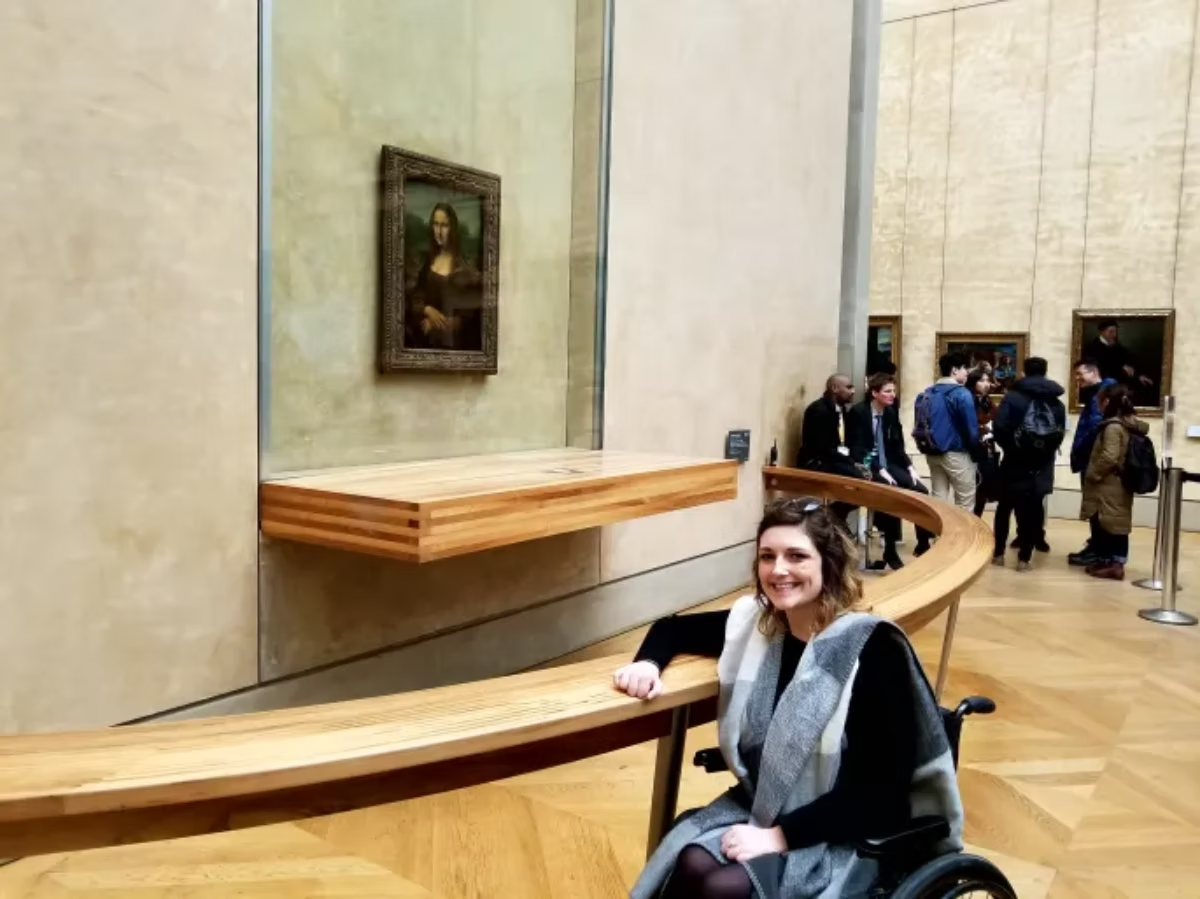
The Louvre is free for disabled visitors and one accompanying person, with priority access (no queuing) at all open entrances. The Carrousel du Louvre is the most wheelchair-friendly entrance — underground, step-free, and climate-controlled. Free wheelchair loans are available at the Hall Napoléon under the Pyramid, along with folding stools, canes, multifunctional rolling chairs, and sensory bags. Elevators reach every floor of every wing, and accessible toilets are available throughout.
The Louvre is, by global museum standards, remarkably accessible. The building is an 800-year-old palace, which creates inherent challenges, but the museum has invested heavily over the past 30 years in making its collections reachable by all visitors. That said, the sheer size of the Louvre means accessibility requires more planning than at smaller museums.
This guide covers everything — free entry, the best entrance, wheelchair loans, lift routes, accessible toilets, and the practical realities of visiting with mobility, sensory, or cognitive access needs.
Free Entry for Disabled Visitors
Entry to the Louvre is free for disabled visitors and one accompanying person (or immediate family member). You’ll need to show official supporting documents — ideally a government-issued disability card from your home country. Free-entry visitors still need to book a time slot in advance to guarantee admission during busy periods.
Who qualifies for free entry
- Visitors with physical, cognitive, sensory, or learning disabilities of any nationality
- One person accompanying each disabled visitor (companion or immediate family)
- Wounded veterans (all nationalities) with certifying documentation
What documentation is required
- A valid government-issued disability card from your home country (preferred)
- A doctor’s note (accepted in some cases, but card is stronger)
- An international disability card, if available
- Original documents only — photocopies are not accepted
How to book the free ticket
Book a free time slot online at ticket.louvre.fr. Select the “free admission” option corresponding to your situation. Even though entry is free, you must reserve a time slot to guarantee admission — especially in peak season when the museum reaches capacity. Bring your documentation to the entrance.
For detailed eligibility beyond disability (under-18s, EEA residents under 26, teachers, etc.), see Louvre Free Entry Days.
The Best Accessible Entrance
The Carrousel du Louvre entrance is the most accessible. It’s entirely underground, completely step-free, has wide corridors and multiple lifts, and connects directly to the metro (Palais Royal–Musée du Louvre, Line 1) and the underground car park. The Pyramid entrance is also accessible via a dedicated tube lift, but the outdoor queue and crowded courtyard can be exhausting for some visitors.
Carrousel du Louvre Entrance (most recommended)
- Location: 99 Rue de Rivoli, or direct from the metro station
- Access: Step-free throughout, flat corridors, lifts available to reach the Hall Napoléon reception
- Advantages: Indoor, climate-controlled, fast, directly connected to accessible transport
- Priority: Disabled visitors and companions skip the queue
Pyramid Entrance
- Location: Cour Napoléon courtyard
- Access: A central glass tube lift descends to the Hall Napoléon; staff are on hand to assist
- Disadvantages: Outdoor queue, cobblestones around the courtyard, high crowd density
- Priority: Disabled visitors and companions skip the queue
Passage Richelieu Entrance
- Access: Step-free and efficient for eligible visitors (groups, members, Paris Museum Pass holders)
- Limitation: Closes at 5:30 PM (7:30 PM on Wed/Fri late openings)
Porte des Lions Entrance
- Access: Ground-level but unreliable hours — do not rely on it for a planned visit
For full entrance comparisons, see Best Louvre Entrance.
Getting to the Louvre Accessibly
By metro
The Palais Royal–Musée du Louvre station (Lines 1 and 7) has accessible platforms on Line 1 — platform-to-street step-free access and lifts. Line 7 at this station is not fully accessible. From the platform, follow signs to “Musée du Louvre” for the direct indoor route to the Carrousel entrance.
By bus
All Paris city buses are wheelchair-accessible with low-floor boarding ramps. Direct Louvre stops: lines 21, 27, 39, 67, 68, 69, 72, 74, 85, and 95.
By car
- Reserved disabled parking spaces are available near the Louvre — see the City of Paris public parking map
- Louvre Carrousel car park (underground, entrance at 1 Avenue du Général Lemonnier) has reduced rates for visitors with disabilities. Arrange at the dedicated area for visitors with special needs under the Pyramid.
- Lifts from the car park lead directly to the Carrousel entrance
By taxi
Drop-off at the Carrousel roundabout (below ground, accessible) is ideal. The closest pick-up point is Place André Malraux.
For full transport details, see How to Get to the Louvre.
Free Equipment Loans
The Louvre loans the following free of charge at the Hall Napoléon (and certain other entrances), in exchange for a piece of ID:
- Manual wheelchairs — roughly 20 available, first-come first-served
- Folding stools — for visitors who can walk short distances but need rest
- Canes — with rubber tips
- Multifunctional rolling chairs — usable as seats, leaning supports, child carriers, or for transporting belongings
- Sensory bags — for visitors with sensory processing needs
- Loaner strollers — for families whose prams are too large for the lifts
Equipment availability is generally best in the morning. For peak season, contact the museum’s accessibility services ahead of your visit via the Louvre’s official accessibility contact form to reserve equipment if possible.
Navigating the Museum by Wheelchair
Lifts and step-free routes
Every wing (Denon, Sully, Richelieu) has multiple lifts reaching all four floors (-1, 0, +1, +2). The museum has 18 lifts and 20 wheelchair-accessible platform lifts in total.
Where you may need to back-track
A few rooms in the Sully Wing have small steps without ramp alternatives. Staff will redirect you to a step-free route when this happens. The Winged Victory of Samothrace is on a platform at the top of the Daru staircase — there’s an adjacent lift that reaches the same level.
The Mona Lisa viewing area
The Salle des États gets extremely crowded, which can be challenging in a wheelchair. The best times for space are before 10:00 AM or after 4:00 PM. Louvre staff will help you navigate to the viewing rope if needed.
Accessibility map
The Louvre provides an accessible-route map showing elevator locations, step-free paths between galleries, and accessible toilets. Currently available in French; pick it up at the Assistance desk under the Pyramid, or ask a staff member for an accessible route recommendation based on what you want to see.
Louvre app
The official Louvre app includes an accessible route planner. Download it before your visit for turn-by-turn step-free navigation.
Accessible Toilets
Accessible toilets are available on every floor of every wing. The cleanest and least busy are typically in the Richelieu Wing, first floor (+1). Baby changing tables are available in several accessible toilets. Some accessible toilets are located within the women’s restrooms — ask a staff member if you need help finding one.
Visitors with Visual Impairments
Touch Gallery (Galerie tactile)
The Louvre’s dedicated Touch Gallery lets visitors with visual impairments (and sighted visitors) tactilely explore replicas of famous sculptures from the museum’s collections. It’s in the sculpture department and is also a highlight for children.
Audio guides
Audio guides are available in 9 languages: French, English, Spanish, Italian, German, Portuguese, Chinese, Japanese, Korean. Rental only on-site on the day of your visit — not bookable online.
Guide dogs
Certified guide dogs and other service animals accompanying visitors with disabilities are permitted throughout the museum.
Visitors with Developmental & Learning Disabilities
The Louvre offers:
- Escort service from the Information Desk — available on request at the Help Desk
- Calm lighting throughout the galleries to reduce sensory overload
- Sensory bags for loan (noise-reducing headphones, fidget tools, etc.)
- Themed visits for visitors with specific access needs
Contact the Louvre’s accessibility services through their contact form in advance for a tailored visit plan.
Visitors Who Are Deaf or Hard of Hearing
- Sign-language tours: Offered in French Sign Language (LSF) on specific dates — check the Louvre’s cultural activities calendar
- Induction loops: Available at ticket counters and in the auditorium
- Written materials: Maps and guide text are in writing, suitable for visitors who prefer visual information
Accessibility Contact
For personalised assistance or to arrange a tailored visit:
- Contact form: Submit via the official Louvre accessibility page
- Phone (answering service): +33 (0)1 40 20 59 90
We strongly recommend contacting the accessibility team a few days before your visit if you have specific needs. They can arrange equipment, reserve parking, plan an accessible route, or provide escort services.
Tips for a Smooth Accessible Visit
Book a time slot even with free entry. Disabled visitors and companions get free entry, but you still need a time slot booking to guarantee admission during peak periods.
Use the Carrousel entrance. It’s the most accessible, the fastest, and it keeps you indoors the whole time.
Arrive at 9:00 AM or after 7:00 PM (Wed/Fri). The galleries are calmest and most navigable at these times.
Plan one or two wings per visit. The Louvre is 72,000 square metres. Attempting the whole museum in a wheelchair means 12 km of rolling — not realistic in one day.
Pack light. Less to carry means easier security and more comfort in the galleries.
Consider a guided accessible tour. A private guided tour with a guide experienced in accessibility solves the planning burden entirely. Pace, route, and breaks are all tailored to you.
Frequently Asked Questions
Is the Louvre free for disabled visitors?
Yes. The Louvre is free for disabled visitors and one accompanying person (a companion or immediate family member), regardless of nationality. You must bring original supporting documents (a disability card from your home country) and book a free time slot online in advance.
Is the Louvre wheelchair accessible?
Yes, the Louvre is extensively wheelchair accessible. The Carrousel du Louvre entrance is step-free throughout, and every wing has multiple lifts reaching all four floors. The museum has 18 lifts and 20 wheelchair platform lifts. A few small rooms in the Sully Wing require detours, which staff can help navigate.
Does the Louvre have wheelchairs to borrow?
Yes. Free manual wheelchairs are available for loan at the Hall Napoléon under the Pyramid, in exchange for a piece of ID. About 20 are available on a first-come, first-served basis. For peak-season visits, it’s wise to contact the accessibility team in advance.
What’s the most accessible entrance to the Louvre?
The Carrousel du Louvre entrance is the most accessible — entirely underground, step-free, climate-controlled, and directly connected to the metro and accessible parking. The Pyramid entrance is also accessible via a central tube lift, but the outdoor crowds can make it more tiring.
Do disabled visitors skip the queue at the Louvre?
Yes. Disabled visitors and one accompanying person get priority access (no queuing) at all reception areas and ticket checkpoints. Show your documentation at the entrance.
Are there accessible toilets at the Louvre?
Yes, every floor of every wing has accessible toilets. The Richelieu Wing’s first-floor toilets are typically the cleanest and least busy. Some accessible toilets are located within the women’s restrooms — ask staff if you need help locating one.
Are service animals allowed at the Louvre?
Yes. Certified guide dogs and other service animals accompanying visitors with disabilities are permitted throughout the museum. Pet dogs, emotional support animals, and uncertified animals are not allowed.
Is there a touch gallery at the Louvre?
Yes. The Touch Gallery (Galerie tactile) is dedicated to visitors with visual impairments and contains replicas of famous sculptures from the museum’s collection that can be tactilely explored. It’s also open to sighted visitors and children.
Can I book an accessible guided tour of the Louvre?
Yes. A private guided tour can be tailored to accessibility needs — pace, route, breaks, and focus can all be customised. Several specialist operators in Paris offer fully wheelchair-accessible Louvre tours.
