

Louvre Greek & Roman Antiquities: Complete Visitor Guide
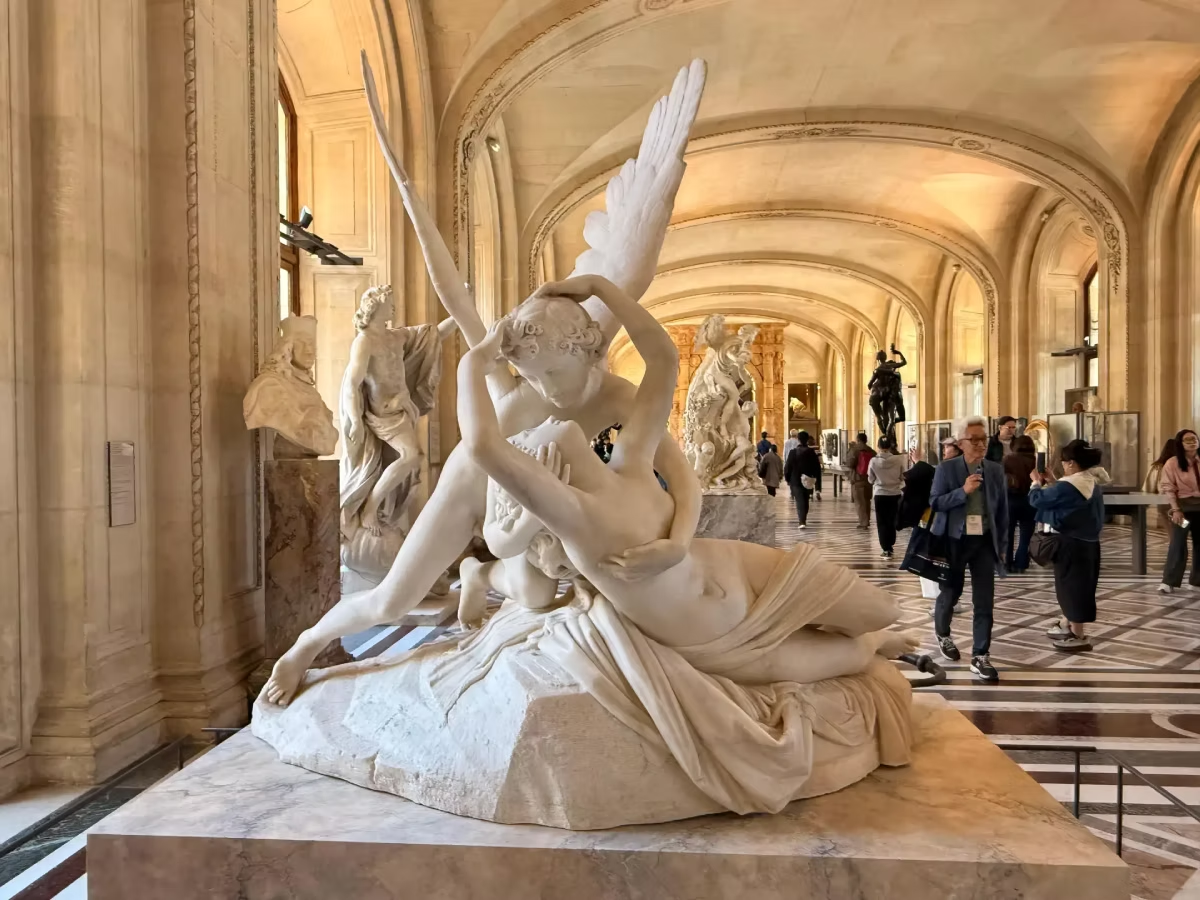
The Louvre’s Department of Greek, Etruscan and Roman Antiquities contains over 45,000 objects across the Sully and Denon Wings. The highlights include the Venus de Milo (Sully, Room 345), the Winged Victory of Samothrace (Daru Staircase, Denon), the Borghese Gladiator, the Sleeping Hermaphrodite, the Diana of Gabii, and an extensive collection of Roman portraiture, Greek vases, Etruscan terracottas, and Cypriot art. Allow 90 minutes to 3 hours.
Two of the Louvre’s three signature masterpieces — the Venus de Milo and the Winged Victory of Samothrace — are part of the Greek, Etruscan and Roman Antiquities department. But the collection goes far beyond those stars. Spanning over 45,000 objects from the Cycladic period (3rd millennium BCE) to Byzantine late antiquity (5th century CE), it traces almost 4,000 years of Mediterranean civilisation in sculpture, ceramics, bronzes, mosaics, and jewellery.
This guide covers where to find the must-see works, the essential visit routes, and the lesser-known highlights that reward the visitors who venture beyond the big two.
Where the Greek & Roman Antiquities Are Located
The collection spans multiple floors and two wings:
- Sully Wing, Level 0 (ground floor): Greek sculpture — Venus de Milo, the Galerie des Antiques, the Borghese Gladiator
- Sully Wing, Level 1: Greek vases, bronzes, ceramics, and smaller objects
- Sully Wing, Level -1 (lower ground): Pre-classical Greek, Cypriot, Etruscan
- Denon Wing, Level 1: Winged Victory of Samothrace (Daru Staircase), some Roman sculpture
How to navigate there
From the Pyramid entrance:
For the Venus de Milo and main Greek sculpture:
- Descend to the Napoleon Hall
- Head to the Sully Wing
- Take the steps up to Level 0
- Follow signs for “Antiquités grecques, étrusques et romaines”
- The Galerie des Antiques contains the Venus de Milo in Room 345
For the Winged Victory:
- Head to the Denon Wing
- Climb the Daru Staircase — she’s at the top (Room 703)
The two masterpieces are about 10 minutes apart walking between them.
Must-See Works
Venus de Milo (Aphrodite)
Where: Sully Wing, Level 0, Room 345
One of the Louvre’s three signature masterpieces — a 2.02-metre Hellenistic marble sculpture of Aphrodite, goddess of love. Discovered on the Greek island of Milos in 1820. Parian marble, c. 150–125 BCE.
For full details, see Venus de Milo at the Louvre.
Winged Victory of Samothrace (Nike)
Where: Denon Wing, Level 1, Room 703 (Daru Staircase)
The second of the Louvre’s three signature masterpieces — a 2.75-metre Hellenistic marble depicting Nike (Victory) alighting on a ship’s prow. Discovered on Samothrace in 1863. Parian marble, c. 190 BCE.
For full details, see Winged Victory of Samothrace.
The Borghese Gladiator
Where: Sully Wing, Level 0, Galerie des Antiques (near the Venus de Milo)
What it is: A 1.57-metre marble sculpture of a warrior caught mid-combat. Signed by Agasias of Ephesus, making it one of the few ancient Greek sculptures with a verified artist signature. Dates to around 100 BCE.
Why it’s special: The dynamic pose captures the warrior bracing against an imagined mounted opponent, shield raised, body twisted in combat. The musculature is anatomically precise — a textbook example of late Hellenistic sculptural technique. Discovered in 1611 near Rome at the Villa Borghese, it entered the French royal collection in 1807 when Napoleon’s brother-in-law Prince Camillo Borghese sold the family collection to France.
The Sleeping Hermaphrodite
Where: Sully Wing, Level 0, Room 348
What it is: A 1.48-metre reclining marble figure of a sleeping hermaphrodite — Hermaphroditus, the child of Hermes and Aphrodite in Greek mythology. The figure lies on a marble mattress carved by Gian Lorenzo Bernini in 1620.
Why it’s special: One of the most technically accomplished Roman copies (c. 2nd century CE) of a lost Greek Hellenistic original. The viewer initially sees a sleeping female figure, then realises on the other side that it’s a hermaphroditic body. The Bernini mattress is itself a masterpiece — marble carved to look like soft fabric pressed by body weight.
What to notice: Walk all the way around. The two viewpoints (from “female side” and “male side”) are deliberately staged.
The Diana of Gabii
Where: Sully Wing, Level 0
What it is: A 1.65-metre marble sculpture of the Roman goddess Diana (Greek Artemis) in a relaxed standing pose. A Roman copy of a Greek original attributed to the sculptor Praxiteles, c. 4th century BCE.
Why it’s special: One of the most complete and well-preserved examples of the Praxiteles style — soft contrapposto, gentle folds of drapery, naturalistic face. Discovered in 1792 near Gabii (a town near Rome).
The Three Graces
Where: Sully Wing, Level 0
What it is: Roman copy of a Greek Hellenistic sculpture showing three nude female figures in a classic symmetrical arrangement — the Charites or Graces of Greek mythology.
Why it’s special: One of the most influential classical compositions, copied endlessly from the Renaissance (Raphael, Botticelli) to Canova.
The Apollo of Piombino
Where: Sully Wing, Level 0
What it is: A 1.15-metre bronze statue of the god Apollo, c. 120–100 BCE. Originally cast in Greece, later recovered from the sea off the coast of Piombino, Italy.
Why it’s special: Rare surviving Greek bronze sculpture (most Greek bronzes were melted down in antiquity for their metal value). The Piombino Apollo is one of the few original Greek bronzes in any Western museum.
Roman Portraiture
Where: Scattered through the Denon and Sully Wings
The Louvre holds one of the most important collections of Roman portrait busts in the world. Highlights include:
- Octavian (Augustus) — multiple portraits showing the first emperor at different ages
- Marcus Aurelius — the philosopher emperor
- Antinous — the young lover of Emperor Hadrian, deified after his death
- Agrippina the Elder — mother of Caligula
Roman portraiture was revolutionary for its psychological realism — unlike idealised Greek heads, Roman portraits show wrinkles, jowls, and individual personalities.
The Vases of the Louvre (Greek Pottery)
Where: Sully Wing, Level 1
A world-class collection of Greek painted pottery:
- Black-figure vases (c. 7th–5th century BCE) — figures painted in black against red clay
- Red-figure vases (c. 5th–4th century BCE) — inverted technique, figures in red against black backgrounds
- White-ground lekythoi — funerary oil containers with delicate painted scenes
Major pieces include work by the Niobid Painter, the Kleophrades Painter, and unnamed masters of the Athenian workshops. Vases tell us more about daily Greek life, religion, and mythology than most sculptural surviving works.
The Cycladic Figurines
Where: Sully Wing, Level -1 (lower level)
Small, minimalist marble figures from the Cycladic civilization (c. 3200–2000 BCE) — among the earliest known figurative art from the Aegean region. Their abstracted geometric forms famously influenced 20th-century modernist sculpture (Brâncuși, Giacometti, Hepworth).
The Etruscan Collection
Where: Sully Wing, Level -1 (lower level)
The Louvre’s Etruscan holdings include:
- Terracotta sarcophagi with reclining figures
- Bronze objects — mirrors, candelabra, urns
- Painted tomb reliefs — some complete sections of tomb walls
The Etruscans (c. 900–27 BCE) were pre-Roman Italian civilization, later absorbed by Rome. Their art is distinctive — more expressive than Greek, less monumental than Roman.
The Campana Collection
Where: Sully Wing, Level 1 and Level -1
Named for the Italian collector Giampietro Campana, whose vast collection was purchased by Napoleon III in 1861. Includes:
- Greek vases (over 11,000 pieces)
- Roman jewellery and bronzes
- Terracottas
- Gilded glass
A major portion of the Louvre’s classical antiquities holdings came from this single acquisition.
The Salle des Caryatides
Where: Sully Wing, Level 0
Not an object, but a room. The Salle des Caryatides is one of the most beautiful spaces in the Louvre — a Renaissance sculpture gallery with four large female caryatid figures (carved by Jean Goujon in the 16th century) supporting a musicians’ tribune. The gallery displays Roman sculpture and has been used for royal receptions, lectures, and even the coronation of King Henri IV.
Suggested Visit Itineraries
Quick visit (45 minutes)
- Venus de Milo (Sully Wing, Room 345) — 10 minutes
- Borghese Gladiator (Galerie des Antiques) — 5 minutes
- Sleeping Hermaphrodite (Room 348) — 5 minutes
- Walk to Denon Wing
- Winged Victory of Samothrace (Daru Staircase) — 10 minutes
- Roman portraiture nearby — 15 minutes
Standard visit (90 minutes – 2 hours)
Must-sees plus the Salle des Caryatides, Diana of Gabii, Apollo of Piombino, and a selection of Roman portraits. Good for a Greek-sculpture-focused visit.
Full visit (3+ hours)
Everything above plus the vases, the Etruscan collection, the Cycladic figurines, and a deep dive into Roman domestic art (mosaics, frescoes from Pompeii).
When to Visit
The Greek and Roman antiquities are less crowded than the Denon Wing paintings. The Sully Wing is generally one of the quieter parts of the museum.
- 9:00 AM opening: Almost empty. The Galerie des Antiques at first light is wonderful.
- Late afternoon (3:00 PM onwards): Calm, with natural light on the marble sculptures.
- Wednesday and Friday evenings: Late opening means you can explore the Sully Wing in near-silence.
- Weekends: Moderately busy but still manageable.
Practical Tips
Start with the Venus de Milo as your anchor. The Galerie des Antiques is easy to orient yourself in — from the Venus, you can radiate outward to the other Greek sculptures.
Plan your route between the two big masterpieces. The Venus de Milo (Sully, Level 0) and Winged Victory (Denon, Level 1) are 10 minutes apart but require navigating between two wings. Check the Louvre Map before you go.
Don’t skip the lower level. The Cycladic and Etruscan collections on Level -1 are genuinely world-class and almost always empty.
Linger at the Sleeping Hermaphrodite. Most visitors walk past the front and miss the point — the other side is essential.
Compare Greek and Roman portraiture. The contrast between idealised Greek heads and realistic Roman portraits is one of the most illuminating walks in any museum.
Use the benches in the Galerie des Antiques. They’re positioned for quiet contemplation of the major sculptures. Take advantage.
Combine with the Egyptian antiquities. The two departments share the Sully Wing and naturally complement each other. A full Sully visit covering Egyptian + Greek + Roman takes about 3 hours.
Context: How the Louvre Became a Classical Antiquities Powerhouse
The Louvre’s classical collection has several origin streams:
Royal collections: The French kings had been collecting classical antiquities since the 16th century. The core royal collection was nationalised with the Louvre’s founding in 1793.
Napoleonic acquisitions: Napoleon’s campaigns in Italy (1796–1798) and Egypt brought thousands of antiquities to Paris. Many were returned after Napoleon’s defeat in 1815, but significant holdings remained.
The Borghese purchase (1807): Prince Camillo Borghese sold the enormous Borghese family collection — assembled over 200+ years in Rome — to France for 13 million francs. This brought major sculptures including the Borghese Gladiator to the Louvre.
The Campana collection (1861): Napoleon III purchased Giampietro Campana’s vast Italian collection, adding 11,000+ Greek vases and thousands of other antiquities.
Archaeological missions: French expeditions in the 19th century — to Mesopotamia, Greece, Asia Minor — brought further acquisitions under the era’s archaeological agreements.
Frequently Asked Questions
Where is the Louvre’s Greek and Roman antiquities collection?
The collection occupies parts of the Sully and Denon Wings across multiple levels. The main Greek sculpture galleries are in the Sully Wing, Level 0 (Galerie des Antiques). The Winged Victory of Samothrace is in the Denon Wing, Level 1 (Daru Staircase). Greek vases and smaller objects are on Sully Level 1. Etruscan and Cycladic objects are on Sully Level -1.
How big is the Louvre’s classical antiquities collection?
Over 45,000 objects spanning the Cycladic period (~3200 BCE) through late Roman antiquity (~5th century CE). It’s one of the three largest classical antiquities collections in the world, alongside the British Museum and the Vatican Museums.
What are the must-see works in the Greek and Roman antiquities?
Three tier-one highlights: the Venus de Milo, the Winged Victory of Samothrace, and the Borghese Gladiator. Secondary must-sees: the Sleeping Hermaphrodite, the Diana of Gabii, the Apollo of Piombino, and the Roman portraiture collection.
How long do I need for the Greek and Roman galleries?
For must-sees only, 45–60 minutes. For a proper visit including vases and secondary sculptures, 90 minutes to 2 hours. For full coverage including Cycladic, Etruscan, and smaller collections, 3+ hours.
What’s the difference between Greek and Roman sculpture?
Generally speaking: Greek sculpture (especially Classical and Hellenistic) idealised human form and emphasised mathematical proportion and beauty. Roman sculpture was more realistic, particularly in portraiture — Romans wanted to look like themselves, wrinkles and all. Roman artists also produced many marble copies of lost Greek bronzes, which is how most famous “Greek” sculptures survive today.
Is the Louvre’s Venus de Milo Greek or Roman?
Greek. She was carved by the Hellenistic Greek sculptor Alexandros of Antioch (c. 150–125 BCE) on the island of Milos. She’s an original Greek work, not a Roman copy — which makes her exceptionally rare.
Where are the Greek vases displayed?
On Level 1 of the Sully Wing. The vase galleries are less crowded than the sculpture galleries and contain over 11,000 ceramic objects, including black-figure and red-figure vases from the major Athenian workshops of the 6th–4th centuries BCE.
What’s the oldest object in the collection?
Objects from the Cycladic civilization (c. 3200 BCE) are among the oldest — roughly 5,000 years old. They’re displayed on Sully Level -1.
Can I take photos in the Greek and Roman galleries?
Yes, without flash. The marble sculptures photograph well in natural light — the Galerie des Antiques has tall windows that provide excellent illumination, especially in the morning.
What’s the Salle des Caryatides?
A spectacular Renaissance gallery on Sully Level 0, named for four large female caryatid figures (carved by Jean Goujon, 16th century) supporting a musicians’ tribune. The room now displays Roman sculptures and is worth visiting for the space itself.
Is the Louvre Greek and Roman collection comparable to the British Museum?
They’re comparably important but differ in focus. The British Museum is especially strong in Egyptian antiquities (the Rosetta Stone) and the Elgin Marbles from the Parthenon. The Louvre has stronger holdings in Greek sculpture (Venus de Milo, Winged Victory), Roman portraiture, and ceramics. Both are essential for any serious study of classical antiquity.
Does Greece want the Venus de Milo or Winged Victory back?
Greece has periodically requested repatriation of both sculptures, as they have with the Elgin Marbles in London. France maintains that both were legally acquired under the laws of the period — the Venus de Milo through an 1820 Ottoman-era transfer, the Winged Victory through an 1863 archaeological mission under French permissions. Neither work appears likely to be returned in the near future.
