

Louvre Hidden Gems: Off-the-Beaten-Path Masterpieces
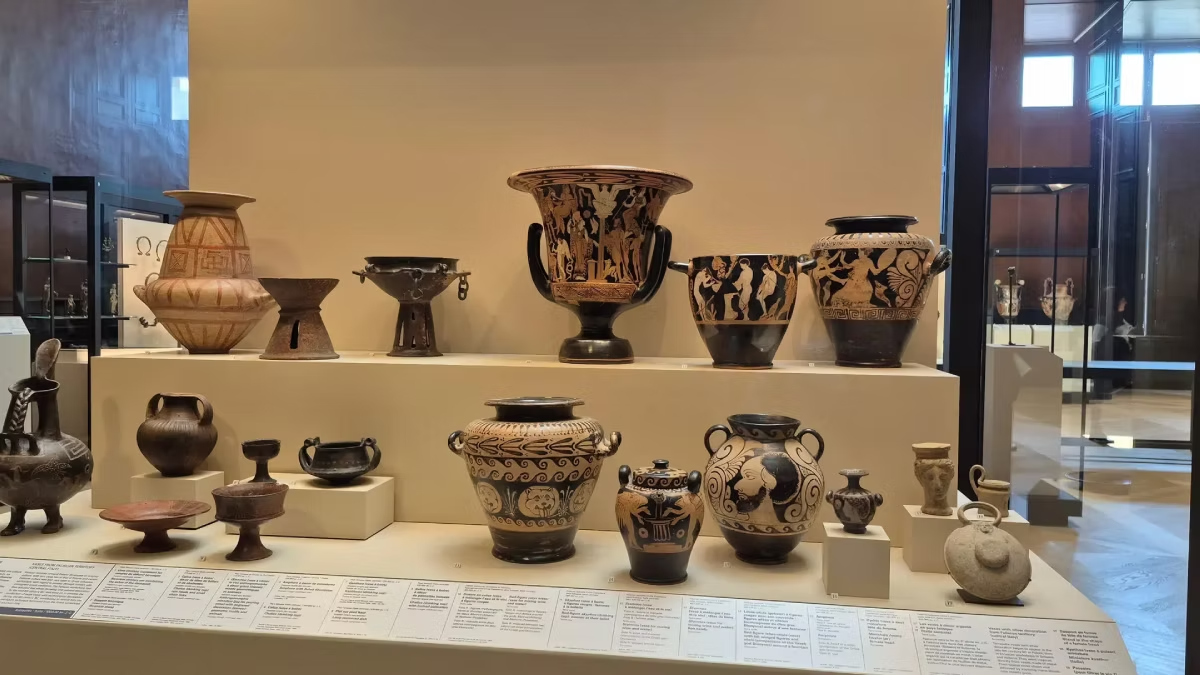
The Louvre’s lesser-known masterpieces deliver nearly empty galleries and quality viewing time that the big three (Mona Lisa, Venus de Milo, Winged Victory) can’t match. Notable hidden gems include Vermeer’s Astronomer, the Sleeping Hermaphrodite, the Napoleon III Apartments, the Cour Marly courtyards, the Sully Wing medieval moat, Fra Angelico’s Coronation of the Virgin, the Cycladic figurines, and the Galerie Campana of Greek vases. These works reward visitors who venture beyond the crowded must-see list.
The Louvre has 35,000 works on display and 80% of its visitors see maybe 30 of them. That’s not the museum’s fault — the Mona Lisa is genuinely worth seeing, and most first-time visitors justifiably prioritise the famous works. But the unsung galleries contain some of the most beautiful and rewarding experiences in the museum.
This guide covers 15 lesser-known masterpieces — works that don’t appear on every “must see” list but deliver extraordinary viewing experiences, often in nearly empty rooms. If you’ve already seen the big three and want a second Louvre visit that feels completely different, start here.
15 Hidden Gems Worth Finding
1. The Napoleon III Apartments
Where: Richelieu Wing, Level 1
What it is: Not a single object but a suite of fully preserved state rooms from the Second Empire, dating to 1852–1861. Created for Napoleon III’s Minister of State, these rooms were used for official entertaining.
Why it’s a hidden gem: Most visitors walk past the entrance without realising what’s inside. The Grand Salon is one of the most lavishly decorated rooms in Paris — red velvet, gold leaf, crystal chandeliers, elaborate ceiling frescoes, and massive gilt mirrors. Adjacent rooms include a formal dining room, library, and reception halls.
What to notice: The scale — these rooms are enormous. The craftsmanship — every surface is decorated. The sense of walking directly into a 19th-century French aristocrat’s life.
How to find it: Richelieu Wing, Level 1. Enter through the marble hall and follow signs for “Napoleon III Apartments.”
2. Vermeer’s The Astronomer
Where: Richelieu Wing, Level 2
What it is: A small 1668 painting by Johannes Vermeer showing a scholar at his desk with a celestial globe. One of only two Vermeers in the Louvre (the other is The Lacemaker).
Why it’s a hidden gem: Most visitors who seek out the Louvre’s Vermeers find The Lacemaker but miss The Astronomer, which is in a different gallery. It’s arguably the more intellectually compelling of the two — a portrait of science and learning at the moment of 17th-century scientific revolution.
What to notice: The light from the window (a Vermeer signature). The detailed globe showing stars and constellations. The astronomer’s concentrated gesture as he reaches to spin the globe.
3. The Sleeping Hermaphrodite
Where: Sully Wing, Level 0, Room 348
What it is: A reclining marble sculpture of the mythological Hermaphroditus — the child of Hermes and Aphrodite — lying on a marble mattress carved by Gian Lorenzo Bernini in 1620. The figure itself is a Roman copy (2nd century CE) of a lost Greek Hellenistic original.
Why it’s a hidden gem: From one angle, it’s a sleeping female figure. From the other, the body is clearly hermaphroditic. This is one of the most surprising works in the Louvre — the gender ambiguity was specifically part of its classical conception. The Bernini marble mattress, sculpted to look like soft fabric pressed by body weight, is a technical marvel.
What to notice: Walk all the way around — the two viewpoints are deliberately staged. Look at the mattress cushions, the folds of fabric impressions.
4. Fra Angelico’s Coronation of the Virgin
Where: Denon Wing, Level 1, Grande Galerie
What it is: A 1430s altarpiece by the Dominican friar-painter Fra Angelico, showing Christ crowning the Virgin Mary surrounded by angels and saints.
Why it’s a hidden gem: Overwhelmingly bypassed by visitors racing toward the Mona Lisa, despite being one of the great Early Renaissance religious paintings. The extensive use of gold leaf and the delicate gradient colours are genuinely breathtaking in person.
What to notice: The architectural setting. The precise halos of gold leaf. The individualised faces of the saints (Fra Angelico was known for painting recognisable people as saints).
5. The Cour Marly and Cour Puget Sculpture Courtyards
Where: Richelieu Wing, Level 0 and -1
What they are: Two covered sculpture courtyards housing French outdoor sculpture from the 17th and 18th centuries — originally created for Louis XIV’s château at Marly-le-Roi (now demolished) and similar palace gardens.
Why they’re hidden gems: Most visitors don’t enter the Richelieu Wing’s sculpture courtyards. The natural light from the glass ceilings, the monumental scale of the sculpture, and the peaceful atmosphere are unique in the Louvre.
Key works: Coysevox’s Mercury Riding Pegasus and Fame Riding Pegasus (originally at Marly), Guillaume Coustou’s Marly Horses (copies; the originals are now in different locations).
What to notice: The architecture of the courtyards themselves — glass ceilings, modern steel, contrasting with 17th-century sculpture. Quiet. Spacious. Genuinely meditative.
6. The Medieval Louvre (Remains of the Medieval Moat)
Where: Sully Wing, Level -2 (lower ground floor)
What it is: The original 12th-century Louvre fortress moat, excavated in 1989 during the Grand Louvre renovation. You walk along a platform above the original stone walls and moat, which were buried and forgotten for centuries.
Why it’s a hidden gem: Most visitors don’t realise the Louvre was originally a medieval castle before becoming a Renaissance palace. Walking through the Medieval Louvre gives you a physical connection to the building’s 900-year history.
What to notice: The massive stone blocks of the original fortress. The central keep (Tour du Louvre). The atmospheric lighting deliberately mimicking the dark, damp feeling of a medieval dungeon.
How to find it: Descend to Level -2 of the Sully Wing. The entrance is at the bottom of a dramatic stone staircase.
7. The Cycladic Figurines
Where: Sully Wing, Level -1
What they are: Small marble figures from the Cycladic civilization (c. 3200–2000 BCE) — one of the earliest known Aegean cultures. Stylised, minimalist human forms carved with extraordinary restraint.
Why they’re hidden gems: Among the earliest sculpted human figures that still speak to modern viewers. Their abstract geometric forms directly influenced 20th-century modernist sculpture — Brâncuși, Giacometti, Hepworth, Modigliani all studied and borrowed from these forms.
What to notice: The folded-arm pose (most are identical). The subtle facial features — originally painted but now worn. The extraordinary stillness.
8. The Galerie Campana (Greek Vases)
Where: Sully Wing, Level 1
What it is: A long corridor displaying thousands of Greek painted vases — black-figure and red-figure ceramics from the 7th through 4th centuries BCE.
Why it’s a hidden gem: The Louvre has over 11,000 Greek vases (most from the Campana collection purchased by Napoleon III in 1861). Almost no one visits these galleries. Yet individually, some of these vases are among the most important survivals of Greek mythology, daily life, and art.
What to notice: The François Vase (if on display — rotating collections). Vases by the Niobid Painter and other named anonymous masters. The range of scenes: gods, heroes, athletes, domestic life, symposia.
9. The Slave Ships of Borda (Victoire) and the Réale Galleys
Where: Denon Wing, Level -1
What they are: Fragments, models, and decorated sterns of 17th and 18th-century French galleys and ships, including the elaborately carved stern of the Réale de France (the flagship of Louis XIV’s Mediterranean fleet).
Why they’re hidden gems: This gallery is almost always empty. The gilded stern carvings are extraordinary — Baroque sculpture applied to working warships. Fascinating naval history combined with extraordinary craftsmanship.
10. The Iran Gallery (Persian Antiquities)
Where: Richelieu Wing, Near Eastern Antiquities
What it is: The Louvre holds one of the best collections of Achaemenid Persian art outside Iran — including the stunning frieze of archers from the Palace of Darius at Susa.
Why it’s a hidden gem: The Frieze of Archers is almost 4.75 metres high and features glazed brick soldiers in processional formation. The colours — blue, gold, brown — are remarkably preserved from 2,500 years ago. This is one of the most visually striking displays in the entire Louvre, yet most visitors never see it.
What to notice: The elaborate dress of the archers (gold jewellery, embroidered robes). The precision of the brickwork. The sheer scale of the frieze.
11. The Decorative Arts Galleries
Where: Richelieu Wing, Level 1
What they are: A series of galleries displaying furniture, tapestries, porcelain, and decorative objects from the French royal collection — spanning the 16th through 19th centuries.
Why they’re hidden gems: Most visitors don’t think of the Louvre as a decorative arts museum (that’s usually the Musée des Arts Décoratifs next door), but the Louvre’s royal decorative arts collection is staggering. Furniture by André-Charles Boulle, tapestries from the Gobelins Manufactory, Sèvres porcelain, Renaissance jewellery.
What to notice: The complete reconstructed rooms — some rooms display furniture, tapestries, and decorative objects in their original configurations.
12. The Denon Wing Antiquities (Mesopotamian Reliefs)
Where: Richelieu Wing, Near Eastern Antiquities, Level 0
What they are: Stone reliefs from the palaces of Assyrian kings, including wall panels from the palace of Sargon II at Khorsabad (near the Winged Bulls).
Why they’re hidden gems: While the Winged Bulls are visited, most visitors skip the adjacent reliefs — which are arguably more historically important. Scenes of royal hunts, military campaigns, and court ceremonies from the 8th and 7th centuries BCE. These are among the earliest examples of narrative relief art.
13. The Louvre Medieval Decorative Arts
Where: Richelieu Wing, Level 1
What it is: Rooms 501–505 display medieval French royal decorative arts — including Joyeuse, the coronation sword of French kings, said to have been used since at least the 13th century (and possibly since the 12th).
Why it’s a hidden gem: Joyeuse is literally the sword that crowned French kings for 500+ years. It’s one of the most historically important objects in France. Yet the gallery receives a fraction of Mona Lisa traffic.
What to notice: The sword itself (with a gold pommel and jewelled hilt). Nearby is Napoleon’s Imperial Crown (Room 504) — another work most visitors miss.
14. The Islamic Art Galleries
Where: Visconti Wing, Level -1 (under the central courtyard)
What they are: A vast collection of Islamic art from the 7th through 19th centuries, displayed in purpose-built galleries under a dramatic wave-shaped golden canopy.
Why they’re hidden gems: Many visitors don’t even know these galleries exist. They were built as part of the 2012 Islamic Art department — a modern architectural intervention in the Cour Visconti. Contains Fatimid ceramics, Ottoman weapons, Mamluk metalwork, Persian miniatures, and some of the greatest Islamic decorative arts outside the Muslim world.
What to notice: The golden canopy ceiling itself — a spectacular piece of contemporary museum architecture. The Pyxis of al-Mughira (10th-century Andalusian ivory carving). Persian carpet fragments. The Bowl of Saint Louis (13th-century Mamluk metalwork given to Louis IX).
15. The Salle des Caryatides
Where: Sully Wing, Level 0
What it is: A 16th-century Renaissance ballroom transformed into a sculpture gallery. Named for four large female caryatid figures carved by Jean Goujon in the 16th century, supporting a musicians’ tribune.
Why it’s a hidden gem: Most visitors walk through quickly to see the Greek sculpture displayed there. But the room itself is one of the most beautiful spaces in the Louvre — a cavernous Renaissance hall with original 16th-century stonework. It was used for royal ceremonies, lectures, and even the coronation of King Henri IV.
What to notice: The caryatids themselves (remarkably elegant female figures). The barrel-vaulted ceiling. The sense of Renaissance-era scale.
Why These Hidden Gems Deliver Better Experiences
You can actually see them
With no crowds, you can stand directly in front of a painting for as long as you want. You can walk around a sculpture from every angle. You can read wall labels. You can photograph without apologising to the people behind you.
Better light and atmosphere
Many hidden gem galleries are quieter than the Mona Lisa room — not just in visitor numbers but in acoustic terms. The Cour Marly sculpture courtyards, the Napoleon III Apartments, the Islamic Art galleries all have naturally calming atmospheres that the Denon Wing’s central arteries lack.
Often in the same wing as famous works
Most hidden gems aren’t physically distant from the main attractions. The Sleeping Hermaphrodite is a 3-minute walk from the Venus de Milo. The Napoleon III Apartments are 5 minutes from the Mona Lisa. A detour to a hidden gem rarely costs more than 10 minutes of extra walking.
They give you a story to tell
Everyone you know has seen the Mona Lisa. Very few have seen the Persian Frieze of Archers, the Medieval Louvre moat, or the Pyxis of al-Mughira. Your Louvre experience becomes genuinely personal rather than “the same visit everyone takes.”
When to See Hidden Gems
Best strategy: second visit. If you’ve already seen the must-see works, a second Louvre visit — ideally on a Wednesday or Friday evening (until 9:45 PM) — is the perfect time for hidden gems.
Alternative: combine with must-sees. If you only have one day, slot 2–3 hidden gems into your main tour. The Sleeping Hermaphrodite is a 5-minute detour from the Venus de Milo. The Napoleon III Apartments are a 10-minute detour from the Mona Lisa.
Late afternoons are ideal. After 4:00 PM, tour groups have cleared. By 5:00 PM, even popular galleries feel empty. The hidden gems are essentially silent during these hours.
Practical Tips
Use the Louvre’s free app. It has detailed floor plans that help locate specific rooms (essential for hidden gems which are often in less-trafficked corners).
Don’t rush. The point of a hidden gem visit is to slow down. Spend 10–15 minutes with each work. Read labels. Sit on benches. Breathe.
Bring a small notebook. Jotting reactions helps the experience stick. You’ll remember the Sleeping Hermaphrodite forever if you write a single line about it.
Visit after a proper lunch. Hidden gem visits are contemplative. Tired, hungry visitors can’t fully engage. Eat first.
Photograph selectively. Many hidden gems photograph poorly (low light, complex compositions). Focus on looking, not capturing.
Respect the quieter atmosphere. These galleries are used to quieter visitor behaviour. Lower your voice. Don’t make phone calls.
Hidden Gem Itineraries
90-minute hidden gem tour
- Start: Napoleon III Apartments (Richelieu Wing, Level 1) — 20 min
- Cour Marly + Cour Puget sculpture courtyards — 15 min
- Islamic Art galleries — 20 min
- Vermeer’s Astronomer (Level 2) — 10 min
- Return to central Louvre
3-hour “second day” hidden gem tour
- Medieval Louvre moat (Sully Wing, Level -2) — 15 min
- Salle des Caryatides (Sully, Level 0) — 10 min
- Sleeping Hermaphrodite (Sully, Room 348) — 10 min
- Galerie Campana Greek vases (Sully, Level 1) — 30 min
- Cycladic figurines (Sully, Level -1) — 20 min
- Walk to Richelieu Wing
- Iran Gallery (Frieze of Archers) — 20 min
- Napoleon III Apartments — 30 min
- Cour Marly + Cour Puget — 20 min
- Islamic Art galleries — 25 min
Frequently Asked Questions
What are the Louvre’s hidden gems?
Works and spaces that most visitors don’t see despite their importance. Notable examples: Vermeer’s Astronomer, the Sleeping Hermaphrodite, the Napoleon III Apartments, the Cour Marly sculpture courtyards, the Frieze of Archers from Persepolis, the Cycladic figurines, the Medieval Louvre moat, and the Islamic Art galleries.
How do I find the hidden gems at the Louvre?
Use the Louvre’s free app or floor plans to locate specific rooms. Most hidden gems are in less-trafficked corners of the museum — the Richelieu Wing, lower levels of Sully, or the purpose-built Islamic Art galleries under the Visconti courtyard.
Why are these hidden gems not famous?
Fame isn’t proportional to significance. The Mona Lisa became globally famous partly because of her 1911 theft, and she’s drawn the spotlight ever since. Equally important works (by Vermeer, Fra Angelico, or from Persian civilization) simply never got the same publicity push.
Are the hidden gem galleries less crowded than the main ones?
Yes, significantly. Galleries like the Islamic Art department, the Napoleon III Apartments, and the Medieval Louvre typically have fewer than 10 visitors at a time, compared to 300+ in the Salle des États.
How long do I need for a hidden gem visit?
For a focused hidden gem tour, 90 minutes to 2 hours. For a comprehensive “second day” visit covering most on this list, 3–4 hours.
Which hidden gem has the most impressive room?
The Salle des Caryatides is arguably the most beautiful room in the Louvre as architecture, though the Napoleon III Grand Salon is the most decoratively lavish. The Islamic Art gallery’s golden wave canopy is the most architecturally modern.
Can I see hidden gems with a guided tour?
Some guided tours include a selection of hidden gems, particularly private tours that can be customised. Most standard group tours focus on the main masterpieces. For hidden-gem-focused tours, ask when booking. See Best Louvre Tour for Your Visit.
Is the Apollo Gallery a hidden gem?
The Apollo Gallery (with the French Crown Jewels) is currently closed following the October 2025 theft. When it reopens, it will be a must-see rather than a hidden gem due to the heist’s publicity. See Apollo Gallery: What to Know in 2026.
Can I see hidden gems on a first Louvre visit?
Yes, but realistically most first-time visitors prioritise the must-see list. A one-day visit can reasonably combine 10–12 of the top 20 must-sees with 3–4 hidden gems. For a genuine deep hidden-gem experience, a second visit is ideal.
Are hidden gems photographable?
Yes, without flash. Many hidden gems are in rooms with less artificial lighting, which can make photography more challenging but also more atmospheric. Modern phone cameras handle low light well.
Do I need a different ticket for hidden gems?
No. All hidden gems listed here are in the Louvre’s permanent collection and are included in any standard ticket.
