

Mona Lisa at the Louvre: The Complete Visitor Guide
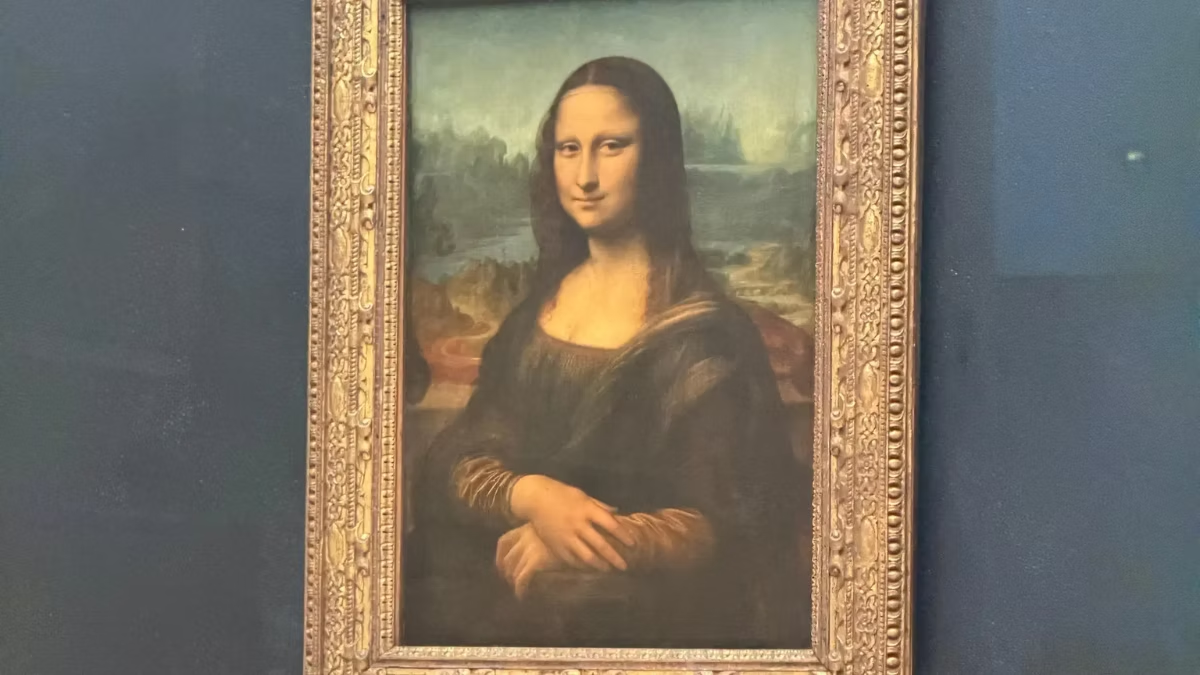
The Mona Lisa (La Joconde in French) is displayed in Room 711, Salle des États, in the Louvre’s Denon Wing, Level 1. The painting is 77 × 53 cm and was painted by Leonardo da Vinci between approximately 1503 and 1519. She sits behind bulletproof glass at a viewing barrier about 4 metres away; most visitors spend 30–60 seconds at the painting. The gallery is crowded from 10:30 AM onwards — arrive at 9:00 AM opening or after 5:00 PM on late-opening days (Wednesdays and Fridays until 9:45 PM) for the clearest view.
She’s the most famous painting in the world. Roughly 80% of the Louvre’s 9 million annual visitors come specifically to see her, and the room where she hangs — the Salle des États — is the busiest space in the museum by a significant margin. Yet many first-time visitors leave disappointed: the painting is smaller than expected, the crowd is denser than expected, and the viewing time at the barrier is shorter than expected.
This guide covers everything you need to know to make your Mona Lisa visit worthwhile — exactly where she is, why she’s so famous, what to expect at the barrier, and the timing strategies that actually work.
Where the Mona Lisa Is Located
The Mona Lisa hangs in the Salle des États, officially Room 711, in the Denon Wing on Level 1. She’s at the centre of the longest wall, displayed behind bulletproof glass in a climate-controlled case.
How to navigate there
From the Pyramid entrance:
- Descend into the Napoleon Hall (the underground lobby)
- Go through ticket control to the Denon Wing stairs
- Climb the Daru staircase (past the Winged Victory of Samothrace)
- Turn right into the Salon Carré
- Walk through the Grande Galerie (the long hall of Italian paintings)
- The Salle des États is on your right, about halfway down the Grande Galerie
From the Carrousel du Louvre entrance: Same route once you enter the Napoleon Hall.
Walking time from the Pyramid: about 10–15 minutes at a normal pace.
What to look for
Inside the Salle des États, she’s immediately obvious — a large crowd gathers in front of the painting at the centre of the room’s longest wall. Opposite her hangs Paolo Veronese’s The Wedding at Cana, which at 6.77 × 9.94 metres is the largest painting in the Louvre. Most visitors don’t notice it because they’re facing the Mona Lisa.
Key Facts About the Mona Lisa
| Artist | Leonardo da Vinci |
| Date painted | Approximately 1503–1519 |
| Dimensions | 77 × 53 cm (30.3 × 20.9 inches) |
| Medium | Oil on poplar wood panel |
| Subject | Believed to be Lisa Gherardini, wife of Florentine merchant Francesco del Giocondo |
| Italian name | La Gioconda |
| French name | La Joconde |
| Current location | Louvre Museum, Denon Wing, Level 1, Room 711 |
| Acquisition | Brought to France by Leonardo in 1516; entered the French royal collection under Francis I |
| Louvre since | 1797 (following the French Revolution) |
| Value | Insurance valuation in 1962 was $100 million — today she’s considered priceless |
Why the Mona Lisa Is So Famous
The Mona Lisa wasn’t always the world’s most famous painting. Her fame accelerated dramatically in the 20th century through a combination of factors:
Leonardo’s technique
Leonardo pioneered sfumato — the technique of blending tones so softly that no lines are visible, particularly in the Mona Lisa’s transitions around her eyes and mouth. This creates the famous “ambiguous expression” that seems to change depending on where you look.
The enigmatic smile
The half-smile at the corners of her mouth is created through subtle shadowing. Viewed directly, the smile seems slight; viewed peripherally, it appears wider. This phenomenon (explained by how different parts of the human retina process light) creates the illusion that her expression changes as you look at her.
The 1911 theft
On August 21, 1911, Italian handyman Vincenzo Peruggia walked out of the Louvre with the Mona Lisa hidden under his coat. The painting was missing for over two years. The theft made worldwide headlines — before 1911, she was well-known only in art circles. After her recovery in 1913, she was a global celebrity. Peruggia was caught trying to sell her to an Italian museum dealer in Florence.
20th-century marketing and reproduction
The Mona Lisa became a universally reproduced image — on postcards, parodies, adverts, and Dadaist art (Marcel Duchamp’s L.H.O.O.Q. of 1919 drew a moustache on a reproduction). The more she appeared in culture, the more famous she became.
Tour de force of a Renaissance master
Leonardo’s technical innovations — sfumato, atmospheric perspective, the three-quarter pose with subtle hand placement — influenced portrait painting for centuries. The painting is a genuine masterpiece regardless of its fame.
The Identity of the Sitter
Art historians overwhelmingly agree she’s Lisa Gherardini, wife of Francesco del Giocondo, a prosperous Florentine silk merchant. The Italian name “La Gioconda” means both “the Giocondo wife” and “the happy one” — a pun Leonardo may have intended.
Francesco commissioned the portrait in 1503 to celebrate the birth of their second son and the purchase of a new family home. Leonardo worked on the painting for over 16 years — carrying it with him to France in 1516 when he moved to the court of King Francis I.
Leonardo never actually delivered the painting. He took it to France, where Francis I eventually acquired it after Leonardo’s death in 1519. It hung in French royal residences for nearly 300 years — at Fontainebleau, then the Palace of Versailles — before entering the Louvre in 1797 after the French Revolution.
What to Expect When You See Her
The viewing experience
The Mona Lisa is displayed behind bulletproof glass inside a climate-controlled display case. A viewing barrier keeps visitors about 4 metres away from the painting. On busy days, this barrier has two queues — a faster-moving line for “quick photo” visitors and a slower line for those who want to look longer.
Typical time at the barrier: 30–60 seconds before staff move visitors along on busy days.
Size reality check
At 77 × 53 cm, she’s smaller than most expect — roughly the size of a medium-format magazine. Many first-time visitors describe their initial reaction as surprise at how small she is. The protective case and viewing distance make her feel even smaller.
The crowd
On peak days (summer weekends, morning hours), 300+ people at a time can be in the Salle des États. The room accommodates this but it can feel overwhelming. Expect:
- Continuous camera flashes (technically forbidden but poorly enforced)
- Selfie sticks (banned but still attempted)
- Groups pushing forward
- Tour guides giving condensed 5-minute lectures
- Families with children, couples, solo art lovers all mixed together
Photography
Photography without flash is allowed. The bulletproof glass creates reflections — taking a clean photo requires getting low, using your phone’s zoom, and angling slightly to avoid window reflections behind you.
When to Visit the Salle des États
Best times for the clearest view
9:00 AM (Louvre opening, all days except Tuesday): The first 30 minutes after opening are the quietest the Salle des États ever gets. Book the earliest available time slot and head directly to Room 711 — don’t stop for anything else.
After 5:00 PM on Wednesday or Friday: The Louvre stays open until 9:45 PM these days. After 5:00 PM, tour groups have left and the gallery clears dramatically. By 7:00 PM, the barrier may have no queue at all.
Times to avoid
10:30 AM – 2:00 PM, every day: Peak crowds. The Salle des États is at maximum capacity.
Weekends (Saturday & Sunday) all day: The busiest days. Early morning is still workable but the “quiet window” closes faster.
School holiday periods: French and European school holidays — especially late July/August and Christmas break — see the highest total visitor numbers.
First Friday evenings Oct–Mar: When the Louvre is free for everyone, the Salle des États is overwhelmingly crowded.
The “Louvre Mona Lisa Guided Tour” option
Tours specifically built around the Mona Lisa are designed to use priority entry and take visitors to Room 711 quickly before the biggest crowds arrive. If the Mona Lisa is your singular focus, this tour can be worth the extra cost. See Louvre Mona Lisa Guided Tour.
What to See Alongside the Mona Lisa
Many visitors rush in and out of the Salle des États — but the room contains some of the Louvre’s greatest Venetian Renaissance works. Don’t miss:
The Wedding at Cana by Paolo Veronese (1563)
Opposite the Mona Lisa. At 6.77 × 9.94 metres, it’s the largest painting in the Louvre. Depicts the biblical wedding where Christ turned water into wine, set in a Venetian architectural setting with over 130 figures. Commissioned for the refectory of San Giorgio Maggiore monastery in Venice. Napoleon’s troops took it to France in 1797.
Other works in the Salle des États
- Titian’s Man with a Glove — a portrait masterpiece
- Tintoretto paintings — dramatic Venetian Baroque work
- Other Veronese paintings — smaller than Cana but still exceptional
The room functions as the Louvre’s Venetian Renaissance gallery — the Mona Lisa is one attraction among many, though she’s obviously the draw.
Nearby galleries worth exploring
- Grande Galerie (Room 710 and adjacent): Leonardo’s other works including Virgin of the Rocks, plus Caravaggio, Raphael, Titian. See Louvre Italian Renaissance Paintings.
- Salle Mollien (Room 700): French Romantic masters — Delacroix’s Liberty Leading the People, Géricault’s The Raft of the Medusa.
- Daru Staircase (Room 703): The Winged Victory of Samothrace. See Winged Victory of Samothrace.
Practical Tips for Seeing the Mona Lisa
Go directly to the Salle des États as your first stop. Don’t stop to admire other works on the way. The first 30 minutes after opening are your best window.
Use the “fast” queue. If the Salle des États has two barriers, the right-hand queue (closer to the painting) moves faster for quick photos.
Get low for photos. The glass reflections are worst when shot at eye level. Crouching slightly eliminates most reflections.
Take two photos: one with flash off, one with portrait mode. The room’s lighting makes a sharp standard shot difficult. Most modern phones handle low-light well on normal mode.
Don’t bring selfie sticks. They’re banned and will be confiscated at the entrance or at the barrier.
Skip the souvenir stops. The Mona Lisa boutique near the exit sells countless reproductions, but the painting itself is what you’re here for.
Stay for The Wedding at Cana. Literally turn around after seeing the Mona Lisa. The painting behind you is the Louvre’s largest and one of its greatest.
Don’t photograph in a way that blocks others. The Salle des États has hundreds of visitors — being considerate about photo stops makes the experience better for everyone.
If you only have 60 minutes at the Louvre, spend 10–15 minutes in Room 711. Entry, barrier queue, photo, and leave. Save the rest of your time for other masterpieces.
Common Misconceptions About the Mona Lisa
“She was always the most famous painting”
No. Before the 1911 theft, she was respected among art historians but not a global celebrity. The theft created her modern fame.
“She’s painted on canvas”
No. Leonardo painted her on a poplar wood panel, which is why she’s relatively small — large wood panels warp. The panel has been carefully stabilised over centuries to prevent cracks.
“The eyes follow you around the room”
This is a famous illusion but the effect is present in many portraits with forward-facing gaze. It’s not unique to the Mona Lisa.
“She’s smiling at something”
The smile is a result of Leonardo’s sfumato technique, particularly at the corners of her mouth. Different interpretations (happy, sad, mysterious) come from how the viewer’s peripheral vision processes the blurred edges.
“You can get close to see brushstrokes”
No. The viewing barrier is about 4 metres away. Detailed brushwork is visible only in high-resolution reproductions — which the Louvre sells at its shop.
“She’s been restored many times”
She hasn’t, actually. The painting has been cleaned and the varnish managed, but the paint surface itself remains largely original — which is remarkable for a 500-year-old panel painting. This is why many of her colours have darkened (aged varnish) but the composition is exactly as Leonardo left it.
The Mona Lisa Through History
- c. 1503–1519: Painted by Leonardo da Vinci. Possibly started in Florence, completed in France.
- 1519: Enters French royal collection after Leonardo’s death. King Francis I acquires her.
- 16th–18th centuries: Hangs in Fontainebleau and Versailles.
- 1797: Transferred to the Louvre Museum after the French Revolution nationalises the royal collection.
- 1804–1814: Napoleon hangs her in his bedroom at the Tuileries Palace before returning her to the Louvre.
- 1911: Stolen by Vincenzo Peruggia. Missing for 28 months.
- 1913: Recovered in Florence; returned to the Louvre.
- 1956: Acid attack and rock thrown at the painting. Bulletproof glass installed as a result.
- 1962–63: Loaned to the USA. Seen by 1.7 million visitors in New York and Washington.
- 1974: Loaned to Tokyo and Moscow.
- 2005: Permanent case with bulletproof glass and climate control installed in the Salle des États.
- 2019: Temporary move to the Galerie Médicis during renovations; returned to the Salle des États.
- 2026: Part of the Louvre’s “Mona Lisa room” redesign plans announced for the late 2020s.
FAQs About the Mona Lisa
Where is the Mona Lisa located in the Louvre?
The Mona Lisa is displayed in the Salle des États (Room 711), in the Denon Wing, Level 1. From the Pyramid entrance, walk through the Napoleon Hall, take the Daru staircase to Level 1, pass through the Salon Carré into the Grande Galerie, and the Salle des États is on your right. The walk takes about 10–15 minutes.
How big is the Mona Lisa?
The Mona Lisa is 77 × 53 cm (30.3 × 20.9 inches) — about the size of a medium-format magazine. Most visitors describe her as smaller than expected. Inside her display case at viewing distance, she appears even smaller.
Who painted the Mona Lisa?
Leonardo da Vinci painted the Mona Lisa between approximately 1503 and 1519. He worked on it for over 16 years, carrying it with him from Italy to France in 1516. After Leonardo’s death, King Francis I acquired it for the French royal collection.
Why is the Mona Lisa so famous?
Multiple factors: Leonardo’s revolutionary sfumato technique, the ambiguous half-smile that seems to change expression, the 1911 theft that made worldwide headlines and elevated her to global celebrity, and her near-universal reproduction in 20th-century culture. She’s also a genuine masterpiece that influenced portrait painting for centuries.
How long can I spend at the Mona Lisa?
On typical busy days, 30–60 seconds at the viewing barrier before staff ask you to move along. At opening (9:00 AM) or late evening (after 5:00 PM on Wednesdays and Fridays), the crowd is thin enough that you can linger longer.
Is the Mona Lisa real or a replica at the Louvre?
It’s the original. The Louvre has never publicly exhibited a replica of the Mona Lisa. Rumours of substitutions are conspiracy theories — modern provenance research, restoration photographs, and micro-analysis confirm authenticity.
Can I take photos of the Mona Lisa?
Yes, without flash. Photos with flash are technically prohibited to protect the painting from light degradation, though enforcement is spotty. Selfie sticks are banned. Professional photography equipment (tripods, large cameras) requires prior permission.
Is there a dress code to see the Mona Lisa?
No specific dress code. Normal museum attire is fine. The gallery enforces no special rules beyond general Louvre conduct (no food, no drinks, no flash). See Louvre Rules: Bags, Photos, Food.
Who was the Mona Lisa modelled on?
Lisa Gherardini, wife of Florentine merchant Francesco del Giocondo. Her Italian name — “La Gioconda” — means both “the Giocondo wife” and “the happy one.” Francesco commissioned the portrait in 1503. The attribution to Lisa Gherardini is based on contemporary sources, though some alternative theories have been proposed over the centuries.
Has the Mona Lisa ever left the Louvre?
Yes, a few times. She was hidden during both World Wars. She was loaned to Washington and New York in 1962–63, and to Tokyo and Moscow in 1974. She hasn’t left the Louvre since, and it’s unlikely she ever will again due to her fragility.
What’s the best time to see the Mona Lisa?
At 9:00 AM when the Louvre opens (any day except Tuesday when it’s closed), or after 5:00 PM on Wednesdays and Fridays when the Louvre is open until 9:45 PM. Avoid 10:30 AM – 2:00 PM, when the crowds are densest.
Why is the Mona Lisa behind glass?
After a rock was thrown at her in 1956, the Louvre installed bulletproof glass. The case has been upgraded multiple times and now also provides climate control (stable temperature and humidity) to protect the fragile poplar panel.
