

Winged Victory of Samothrace: Visitor Guide
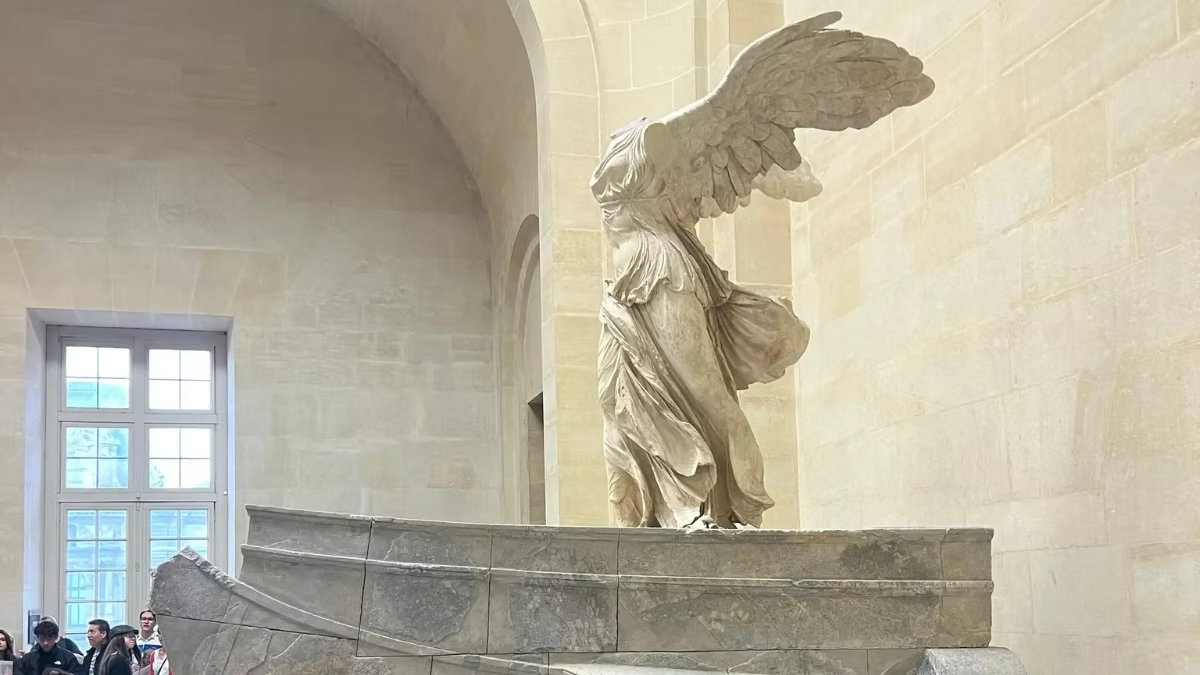
The Winged Victory of Samothrace (Nike of Samothrace) stands at the top of the Daru Staircase (Room 703) in the Louvre’s Denon Wing, Level 1. Carved from Parian marble around 190 BCE, she depicts the Greek goddess Nike descending onto the prow of a warship. The statue is 2.75 metres tall; the total monument including the ship’s-prow base is 5.57 metres. She was discovered in 1863 on the Greek island of Samothrace by French diplomat Charles Champoiseau and has been at the Louvre since 1884. Her head and arms are missing and have never been found.
She’s frequently called the most dramatic sculpture in the Louvre. Positioned at the top of a monumental staircase, with her wings spread and her robe streaming in an invisible sea wind, the Winged Victory of Samothrace is meant to be seen in motion — as if she’s just alighted onto the prow of a warship to announce a naval victory. The Louvre has staged her carefully: you climb the Daru Staircase and she appears progressively, seeming to grow larger and more imposing with each step. It’s one of the most theatrical presentations of art anywhere in the world.
This guide covers where to find her, the story of her discovery, what to look for, and how she fits into the Louvre’s “big three” masterpieces alongside the Mona Lisa and Venus de Milo.
Where the Winged Victory Is Located
The Winged Victory of Samothrace stands at the top of the Daru Staircase, officially Room 703, in the Denon Wing on Level 1. She’s one of the first major works most visitors encounter, as the Daru Staircase is the main route from the ground floor to the Italian and French painting galleries.
How to navigate there
From the Pyramid entrance:
- Descend into the Napoleon Hall
- Head to the Denon Wing (signs direct you toward “Peintures italiennes” and “Mona Lisa”)
- The Daru Staircase is directly ahead of you as you enter the Denon Wing
- She appears at the top of the staircase — you’ll see her as you begin climbing
Walking time from the Pyramid: 5–7 minutes.
The staged presentation
The Louvre has positioned the Winged Victory for maximum dramatic effect. Starting from the ground floor:
- From below (beginning the climb): You see her silhouette against the natural light from above. Her wings seem to fill the frame.
- Midway up the staircase: She grows larger and more detailed. The fabric of her robe starts to become legible.
- At the top of the staircase: You’re face-to-face (well, face-to-chest) with one of the greatest surviving Greek sculptures, with the full prow-of-ship base revealed.
This was deliberately staged by Louvre architects in the 1930s to replicate the effect of her original position at the Sanctuary of the Great Gods on Samothrace, where she sat in a hillside niche overlooking the Aegean.
Key Facts About the Winged Victory
| Date | Approximately 190 BCE (early Hellenistic period) |
| Height (statue alone) | 2.75 metres (9 ft) |
| Height (total monument including base) | 5.57 metres (18 ft 3 in) |
| Material (statue) | Parian marble |
| Material (ship’s-prow base) | Lartos marble from Rhodes |
| Weight | Approximately 30 tonnes |
| Subject | Nike, the Greek goddess of victory, alighting on a ship’s prow |
| Discovered | April 15, 1863, on the island of Samothrace, Greece |
| Discovered by | Charles Champoiseau, French consul and amateur archaeologist |
| Acquired by France | 1864 — shipped to the Louvre |
| Installed at Daru Staircase | 1883 |
| Current location | Louvre Museum, Denon Wing, Level 1, Room 703 |
| Head and arms | Missing — never recovered |
Why the Winged Victory Is a Masterpiece
The illusion of movement
More than almost any ancient sculpture, the Winged Victory communicates motion. Three effects combine:
- The wings are outstretched — captured mid-flight, not folded in rest
- The body leans forward — she’s decelerating as she lands on the prow
- The robe streams backward — the invisible wind of her flight has pushed the fabric behind her
Ancient sculptors could have shown her standing at rest, as most Greek statuary did. By staging her in the instant of landing, the sculptor created a work that feels alive.
The “wet drapery” technique
Her robe appears to cling to her body as if soaked through — a demanding sculptural technique where thin marble drapery reveals the body beneath. The folds around her thighs and the billowing fabric trailing behind are technical achievements that place this work among the finest of Greek sculpture.
An original, not a copy
Most Greek sculptures we have in modern museums are Roman marble copies of earlier Greek bronze originals. The Winged Victory is a rare original Greek marble sculpture from the Hellenistic period. This makes her irreplaceable in a way the Apollo Belvedere or the Discobolus (both Roman copies) are not.
A votive monument, not a decoration
She wasn’t decoration. She was a religious offering, commissioned in thanksgiving for a naval victory and installed at the Sanctuary of the Great Gods on Samothrace — a mystery-cult religious site that attracted pilgrims from across the Greek world for centuries.
The Story of Her Discovery
In April 1863, Charles Champoiseau, a French diplomat serving as acting consul at Adrianople (modern Edirne, Turkey), arrived on the island of Samothrace in the northeast Aegean. Samothrace was known for antiquities, and Champoiseau had secured a small French government grant of 2,000 francs to investigate.
On April 15, 1863, Champoiseau’s diggers uncovered the right section of a marble female bust. More fragments were soon unearthed — 118 pieces total, including drapery, wings, and the lower body. Nearby they also found about 15 large grey marble blocks that Champoiseau initially dismissed as unrelated (he thought they were from a tomb). He sent the statue fragments to the Louvre, leaving the grey blocks on site.
Arrival in Paris: The pieces arrived at the Louvre on May 11, 1864. Curator Adrien Prévost de Longpérier undertook the first restoration between 1864 and 1866, assembling what he could of the body. The statue was displayed without wings or base — and initially attracted little public attention.
The critical 1875 discovery: Austrian archaeologists working at Samothrace studied Champoiseau’s abandoned grey marble blocks and realised they formed the tapered bow of a warship. The architect Aloïs Hauser recognised that, properly assembled, these blocks would create the ship’s-prow base for the Winged Victory. Coins from the era showed Victories standing on ship prows, confirming the design.
Second French expedition (1879): Champoiseau returned to Samothrace and recovered the ship’s-prow base pieces. They were shipped to the Louvre and assembled with the statue between 1880 and 1883.
1883 installation: The fully reconstructed Victory was placed at the top of the Daru Staircase. Her fame exploded — she became one of the most celebrated works in Western art within a decade.
1950 hand discovery: American archaeologists excavating at Samothrace found her right hand — open-palmed, with two outstretched fingers. This is displayed in a separate case near the main sculpture. The palm indicates she was not holding anything but was raised in a gesture of greeting or proclamation.
What to Look For
Approach her in stages
- From the bottom of the Daru Staircase: The Winged Victory is designed to be seen from this angle — her silhouette against the light, the upward angle of her wings, the torso leaning forward in motion. This is the “intended viewpoint.” Pause and take it in before climbing.
- From halfway up: The drapery’s details become clearer. Notice the shoulder strap, the belt detail, and the contrast between the compressed drapery at her waist and the billowing fabric behind her.
- At the landing: You can walk around her (maintaining the appropriate distance). The back of the sculpture is almost as detailed as the front — worth a full 360-degree examination.
Details to notice
- The wings: Made of Parian marble, the surviving original portions are supplemented by plaster fills where fragments were missing. Look closely — the original marble and the plaster additions have slightly different textures and colours. The right wing is largely a 19th-century plaster reconstruction; the left wing has more surviving original material.
- The ship’s prow base: Look at the dolphin-shaped ornamentation on the side of the prow. The base is carved from grey Lartos marble (from Rhodes) — a deliberate colour contrast to the statue’s white Parian marble, emphasising separation between the goddess and her pedestal.
- The drapery folds: The complexity of the drapery is extraordinary. Fabric layers, belts, clinging wet-drapery effects, and a streaming cloak all combine in what is essentially a lesson in Hellenistic sculptural virtuosity.
- The missing head: Her head has never been found. Art historians speculate she probably wore a crown of oak leaves or held a trumpet to her lips. The head likely faced slightly right, as her torso turns that way.
The Hand of Victory
In a separate glass case nearby (Room 703, Escalier Daru, Level 1), the open right palm discovered in 1950 is displayed. Her raised hand was probably a gesture of greeting — welcoming the returning victorious sailors. It’s a remarkable small detail worth examining.
When to Visit Her
The Winged Victory is always on display (unless during rare closures for restoration). She’s the most photographed sculpture in the Louvre apart from the Mona Lisa.
Best times for viewing
- 9:00 AM opening: You can climb the Daru Staircase in peace. Very few visitors are there yet. Her silhouette against the morning light is spectacular.
- After 5:00 PM on Wednesdays and Fridays (late opening): Tour groups have cleared. Calm, cinematic views.
- Weekday afternoons (Mon, Wed, Thu, Fri) 3:00–5:00 PM: Still moderately busy but manageable.
Times to avoid
- 10:30 AM – 2:00 PM: The staircase has a steady flow of visitors heading to the Mona Lisa. The landing gets crowded.
- Weekend mornings: Peak crowd density, though her commanding presence makes her visible even through crowds.
Why She’s Worth Lingering Over
Most visitors pass the Winged Victory in 60 seconds on their way to the Mona Lisa — which is a mistake. She repays careful attention in a way few sculptures can.
Take 10 minutes at least. Walk down to the base of the Daru Staircase, then climb slowly, pausing at each landing to see how her appearance changes. Circle her at the top. Examine the Hand of Victory nearby. Notice the marble floor and mosaic ceiling.
The experience is quieter than the Mona Lisa room. Even when crowded, the Daru Staircase is a vast space — the Victory herself is 5.57 metres tall with her base, so the sense of scale pulls everyone’s attention upward, not toward each other.
Photography is excellent. Natural light from above, the commanding scale, the dramatic pose — she’s one of the easiest iconic sculptures to photograph well. Try shooting from the base of the staircase for the full silhouette, and from the landing for dramatic close-ups.
Nearby Highlights
The Daru Staircase connects several major Louvre galleries:
- Grande Galerie (Denon Wing): After the Winged Victory, continue up and turn right into the Salon Carré, which leads to the Grande Galerie with Leonardo, Raphael, Caravaggio. See Louvre Italian Renaissance Paintings.
- Mona Lisa (Room 711): A 5-minute walk from the top of the staircase. See Mona Lisa at the Louvre.
- French Romantic paintings (Room 700, Salle Mollien): Liberty Leading the People, The Raft of the Medusa — 2 minutes from the top of the staircase.
- Greek antiquities (Sully Wing, Level 0): Including the Venus de Milo. See Venus de Milo at the Louvre.
Practical Tips for Visiting
Approach her from the bottom of the Daru Staircase. The sculpture is designed to be seen from this angle — don’t enter the Daru landing from a side route if possible.
Pause on each landing. Three distinct viewpoints as you climb — each reveals different details.
Find the Hand of Victory. The 1950 palm discovery is displayed in a glass case nearby. Most visitors miss it entirely.
Don’t stand directly below her for photos. The best angle is about 10 metres back from the base of the staircase — this captures her full silhouette against the natural light.
Use the staircase as part of the visit. The Daru Staircase itself is a masterpiece of 19th-century architecture. Notice the mosaic decoration, the Second Empire stonework, and the way the staircase widens as it ascends.
Visit the Victory of Samothrace early in your Louvre visit. She’s often the first major sculpture you encounter. Don’t rush past her on your way to the Mona Lisa — you’ll regret it.
Listen for the audio guide commentary. The Louvre’s free app has an excellent segment on the Winged Victory, explaining the restoration history and the staging.
The Winged Victory Through History
- c. 190 BCE: Created in the early Hellenistic period, possibly commissioned to commemorate a Rhodian naval victory
- Antiquity: Stood in a hillside niche at the Sanctuary of the Great Gods on Samothrace, visible to pilgrims approaching the site
- April 15, 1863: Discovered by Charles Champoiseau
- May 11, 1864: Arrives at the Louvre
- 1866: First restoration completed; displayed in the Louvre
- 1879: Ship’s prow base discovered and shipped to Paris
- 1880–1883: Reconstructed with base and wings
- 1883: Installed at the top of the Daru Staircase
- 1932–1934: Daru Staircase redesigned in its current Art Deco–influenced form
- 1939: Moved to Château de Valençay during WWII
- July 1945: Returned to the Daru Staircase
- 1950: Right hand discovered by American archaeologists at Samothrace
- 2013: Major restoration completed for the 150th anniversary of her discovery — current appearance reflects this work
Frequently Asked Questions
Where is the Winged Victory of Samothrace located?
The Winged Victory stands at the top of the Daru Staircase (Room 703) in the Denon Wing, Level 1. She’s visible from the bottom of the staircase as you begin climbing — the Daru Staircase is the main route from the ground floor to the Italian paintings galleries.
How tall is the Winged Victory?
The statue itself is 2.75 metres (9 feet). Including the ship’s-prow base she stands on, the total monument is 5.57 metres (18 feet 3 inches) tall. She weighs approximately 30 tonnes.
Who made the Winged Victory of Samothrace?
The sculptor is unknown. The statue was created around 190 BCE by an anonymous Greek sculptor working in the early Hellenistic period. She may have been commissioned by the people of Rhodes to commemorate a naval victory, though the specific battle and patron remain uncertain.
Why is the Winged Victory’s head missing?
Her head and arms were broken off at some point in antiquity (possibly when the sanctuary at Samothrace was destroyed) and have never been found. Despite extensive excavations, none of the fragments have included head pieces that could be attached.
When was the Winged Victory discovered?
She was discovered on April 15, 1863, by French diplomat Charles Champoiseau on the island of Samothrace. 118 pieces were uncovered over the course of his excavation. Additional fragments — the ship’s-prow base and the right hand — were found later in 1879 and 1950 respectively.
Why is the Winged Victory on a staircase?
The Louvre deliberately placed her at the top of the Daru Staircase in 1883 to replicate the dramatic effect of her original position in a hillside niche at the Sanctuary of the Great Gods on Samothrace. In both locations, viewers approach her from below and see her revealed progressively.
What does the Winged Victory represent?
She depicts Nike (Victory), the Greek goddess of victory, descending onto the prow of a warship. The pose captures the moment she alights — she’s meant to be interpreted as a divine messenger announcing a naval victory. The ship’s prow is integral to the composition.
Is the Winged Victory behind glass?
No. Like most Louvre sculptures, she’s displayed freestanding on her pedestal at the top of the Daru Staircase. There’s a barrier preventing direct contact, but you can walk around her at normal museum distance.
Was the Winged Victory originally painted?
Originally yes, though the paint has long since worn away. Like most ancient Greek sculptures, she was painted in vivid colours — hair, eyes, skin tones, and drapery details. Modern restoration work on other ancient sculptures has confirmed that Greek marble sculptures were never meant to be the stark white we see them as today.
Can I take photos of the Winged Victory?
Yes, without flash. She’s one of the easiest iconic Louvre sculptures to photograph well due to the natural overhead light and her commanding presence against the staircase backdrop. The view from the base of the staircase captures her in full silhouette.
Could the Winged Victory be returned to Greece?
Greece has periodically requested her return (as they have with the Elgin Marbles in London). France maintains that she was legally acquired under Ottoman-era law that governed antiquities transfers. The Louvre considers her a permanent part of its collection.
What is the Hand of Victory?
The Winged Victory’s right palm, discovered in 1950 at Samothrace and displayed in a glass case near the main sculpture. It’s open with outstretched fingers, showing she wasn’t holding anything — she was likely raising her hand in a gesture of greeting or proclamation.
