

Louvre + Musée d’Orsay Combo
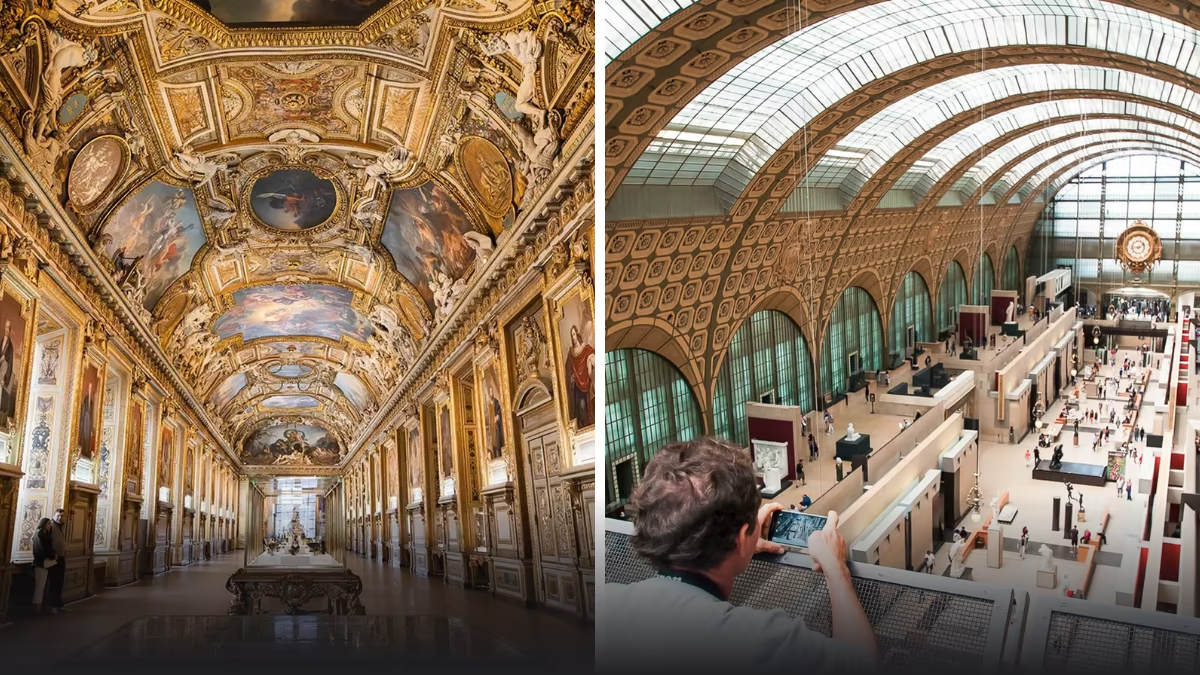
The Louvre + Musée d’Orsay combo ticket bundles reserved-access entry to both museums. The Louvre covers art from antiquity through the mid-19th century; Musée d’Orsay picks up where the Louvre ends, covering Impressionists and Post-Impressionists. They’re 10 minutes apart on foot across Pont Royal. Both tickets are timed and typically valid for the same day. The combo is the single best art-focused day in Paris for serious museum-goers.
If you want to understand the full sweep of Western art in one day, the Louvre and Musée d’Orsay are the answer. The Louvre goes from ancient Egypt through the French Romantics (roughly 3,000 BC to 1848). The Musée d’Orsay picks up exactly where the Louvre ends, covering the late 19th century’s artistic revolution — Impressionism, Post-Impressionism, the birth of modern art. Together they form the most complete art experience in Europe, and they’re a 10-minute walk apart.
This guide describes the Louvre + Musée d’Orsay combo ticket in full — what’s included, what you’ll see at each museum, how to plan the day, and tips for the world’s greatest art walkabout.
Top Tickets
What’s Included in the Combo
When you book, here’s what you get:
- Reserved-access Louvre entry within a 30-minute booked window
- Reserved-access Musée d’Orsay entry within a booked time slot
- Priority lanes at both museums via dedicated ticket-holder entrances
- Full access to both permanent collections and their temporary exhibitions
- Combined savings — typically 10–15% cheaper than buying each separately
- Mobile tickets — QR codes for both attractions
- Same-day or split-day use — depends on specific product
The two museums are remarkably complementary:
- The Louvre closes its story around 1848 — after the French Romantics
- The Musée d’Orsay opens its story in 1848 — starting with Realism, then moving to Impressionism, Post-Impressionism, and early modernism
- Together they run from 3,000 BC to 1914 — essentially the full history of Western art
The 10-minute walk between them across Pont Royal is itself one of the best strolls in central Paris.
Buy This TicketWhat You’ll See at Each Museum
At the Louvre (morning, 3–4 hours)
The Louvre’s collection spans ancient civilisations through the French Romantics. Priority highlights:
- Mona Lisa — Leonardo da Vinci’s iconic portrait
- Winged Victory of Samothrace — Hellenistic sculpture masterpiece
- Venus de Milo — ancient Greek marble
- Liberty Leading the People — Delacroix’s French Romantic icon (1830)
- The Raft of the Medusa — Géricault’s massive Romantic painting
- Italian Renaissance paintings — Raphael, Titian, Veronese, Caravaggio
- Egyptian antiquities — the Seated Scribe, the Great Sphinx of Tanis
- Code of Hammurabi — one of humanity’s oldest legal codes
- Napoleon III Apartments — Second Empire state rooms
See our Louvre in One Day itinerary for a detailed route.
At the Musée d’Orsay (afternoon, 2–3 hours)
The Musée d’Orsay occupies a former Beaux-Arts train station (Gare d’Orsay, 1900) and focuses on art from 1848 to 1914. The building itself is a masterpiece — a grand glass-roofed nave with gallery spaces on multiple levels.
Must-see works:
- The Starry Night Over the Rhône — Vincent van Gogh
- Bedroom in Arles — Van Gogh
- Self-Portrait (1889) — Van Gogh
- Water Lilies — Claude Monet (though the Orangerie has the famous mural-scale Water Lilies series)
- Impression, Sunrise (loaned on occasion) — Monet
- Olympia — Édouard Manet
- Luncheon on the Grass — Manet
- Ball at the Moulin de la Galette — Renoir
- The Card Players — Paul Cézanne
- Little Dancer of Fourteen Years — Edgar Degas
- The Gleaners — Jean-François Millet
- The Thinker — Auguste Rodin (some casts displayed here)
The collection in one sentence: If you’ve ever seen a reproduction of an Impressionist painting, there’s a strong chance the original is here.
The chronological story, end to end
Start at the Louvre at 9:00 AM with Egyptian antiquities from 3,000 BC, end at the Musée d’Orsay at 4:00 PM with Van Gogh’s Bedroom from 1889. In between, you’ve covered 5,000 years of art history in a single day. No other city in the world lets you do this.
Ticket Details at a Glance
| Details | |
|---|---|
| Louvre entry | Reserved, 30-min window |
| Orsay entry | Reserved, 30-min window (usually) |
| Distance between | 10 minutes on foot across Pont Royal |
| Same-day use | Standard |
| Valid across days | Some products only |
| Typical savings | 10–15% vs. separate tickets |
| Mobile tickets | ✓ |
| Cancellation | Varies by reseller |
| Louvre hours | 9 AM–6 PM (9:45 PM Wed/Fri), closed Tuesdays |
| Orsay hours | 9:30 AM–6 PM (9:45 PM Thu), closed Mondays |
Important: The Louvre is closed Tuesdays and the Musée d’Orsay is closed Mondays. Plan your combo for any day except Monday or Tuesday.
The Ideal Day Itinerary
9:00 AM: Louvre opens
Start with a 9:00 AM Louvre slot. Galleries are at their quietest and the Mona Lisa queue is manageable. Head to the Denon Wing first — it has the biggest crowds later in the day.
9:00 AM – 12:30 PM: Louvre highlights
3.5 hours covers the Denon Wing (Mona Lisa, Italian paintings, French Romantics), plus Venus de Milo in Sully and Winged Victory on the Daru staircase. Save Sully and Richelieu’s other sections for a future visit if time runs short.
12:30 PM – 1:30 PM: Lunch
Eat at one of the Louvre cafés or walk toward the Seine and eat at a bistro on Quai Voltaire (the route toward Orsay).
1:30 PM – 2:00 PM: Walk to the Musée d’Orsay
Cross Pont Royal — one of the most scenic short walks in Paris. You’ll cross the Seine with the Louvre behind you and the Musée d’Orsay’s clock tower ahead. 10 minutes total.
2:00 PM: Arrive at Musée d’Orsay
Show your reserved-access ticket at the dedicated entrance. Security takes 5–10 minutes.
2:00 PM – 5:00 PM: Musée d’Orsay
Start on the 5th floor (the Impressionist galleries) — this is what most visitors come for, so start where your energy is highest. Then work your way down through Post-Impressionism, Realism, and sculpture.
Priority route:
- 5th floor: Impressionism (Monet, Manet, Renoir, Degas, Pissarro, Sisley)
- 5th floor: Post-Impressionism (Van Gogh, Cézanne, Gauguin, Seurat)
- 2nd floor: Art Nouveau decorative arts
- Ground floor: Sculpture, Realism, the Gustave Courbet gallery
5:00 PM onwards: Dinner or onward
The Musée d’Orsay’s surrounding neighbourhood (7th arrondissement, Saint-Germain-des-Prés) is full of classic Parisian bistros and cafés. Perfect for an early dinner after a long art day.
Who This Combo Is For
The Louvre + Musée d’Orsay combo suits specific visitors:
Serious art lovers who want to see the full sweep of Western art in one day.
First-time Paris visitors who know both museums are essential.
Repeat visitors who’ve done the Louvre and want to extend to Orsay (or vice versa).
Impressionism enthusiasts — Orsay has one of the world’s greatest Impressionist collections.
Couples on culture-focused trips wanting two complementary museum experiences.
Visitors on a tight schedule who need to maximise their cultural intake per day.
If you’re doing 3+ Paris attractions, compare this to the Paris Museum Pass — which includes both museums plus 48 others. For just these two, the standalone combo is cheaper.
Why This Combination Works Specifically
The museums don’t compete. The Louvre ends where Orsay begins — no overlap. You’re not seeing the “same thing twice.”
The walk between them is part of the experience. Crossing Pont Royal with the Seine beneath you is itself a Paris moment.
Orsay is smaller and less exhausting than the Louvre. After 3.5 hours at the Louvre, Orsay’s smaller footprint (3 hours is plenty) is a natural afternoon activity rather than another full museum marathon.
The chronology is perfect. You start with ancient civilisations, end with the first true modernists. It’s a single story told across two venues.
Scheduling is simple. Both are open most days except Mondays (Orsay) and Tuesdays (Louvre). Any other day works.
Practical Information
Entry rules
Louvre: 55 × 35 × 20 cm bag limit, no selfie sticks, no food. See Louvre Rules.
Orsay: Similar bag limit, similar rules. Photography allowed without flash in most galleries.
Photography
Non-flash photography is allowed throughout both museums’ permanent collections. Some temporary exhibitions at Orsay prohibit photography.
Accessibility
Louvre: Extensively wheelchair-accessible. See Louvre Accessibility.
Orsay: Wheelchair-accessible with lifts to all gallery levels. Wheelchairs available free at the entrance (first-come, first-served).
Getting between them
The 10-minute walk across Pont Royal is the scenic option. Alternatively:
- Taxi/Uber: 5 minutes, €8–12
- Metro: Line 1 from Tuileries to Solférino via Concorde (2 stops), then 5-minute walk
- Bus: Line 83 or 84 stops near both museums
Walking is almost always the best choice — the route is iconic.
Where to eat between the museums
On the walk from Louvre to Orsay:
- Café Marly (on the Louvre colonnade) — stop before leaving
- Angelina (226 Rue de Rivoli) — famous hot chocolate
- Quai Voltaire bistros — classic Parisian lunches near the Seine
- Saint-Germain area — restaurants near Orsay
Louvre vs Orsay fatigue
A common question: should you save one museum for another day? Most serious art lovers can handle both in one day if they:
- Sleep well the night before
- Eat a proper lunch between
- Skip the comprehensive “see everything” approach and focus on highlights
- Take sitting breaks when possible
Younger children (under 10) usually can’t handle both in one day — save Orsay for a second trip.
When to Book
- Peak season (April–October): 2–3 weeks ahead
- Shoulder season: 1–2 weeks
- Low season: A few days ahead
Avoid Mondays (Orsay closed) and Tuesdays (Louvre closed).
Best days for this combo: Wednesday (both open; Louvre has late hours if you want to extend), Thursday (both open; Orsay has late hours), and Sunday (both open; weekend atmosphere).
Tips for Making the Most of the Combo
Don’t skip the Louvre’s Richelieu Wing. It’s the quietest and contains the stunning Napoleon III Apartments and Cour Marly sculptures. Brilliant morning detour after the Denon Wing highlights.
Do Orsay’s Impressionist floor first. It’s why most people come, and fatigue builds as the day goes on. Start on the 5th floor and work down.
Take the Pont Royal walk — don’t metro. Seriously. The Seine view with the Louvre behind and Orsay ahead is one of Paris’s best free experiences.
Skip photographs of famous paintings. You can find perfect reproductions online. Use your eyes instead.
Plan dinner in Saint-Germain. Some of Paris’s best classical bistros are 5–10 minutes from Orsay — Le Comptoir du Relais, Les Editeurs, or the legendary Brasserie Lipp on Boulevard Saint-Germain.
Consider the evening Louvre option. On Wednesdays and Fridays the Louvre stays open until 9:45 PM. You can do Orsay in the morning, lunch, and evening Louvre — reversing the standard flow. Often quieter.
Pack light. Bag rules are enforced at both museums. A small daypack with water, phone, wallet, and a scarf is plenty.
Hydrate constantly. 6 hours of museum walking is more tiring than most visitors expect.
Buy This TicketFrequently Asked Questions
Is the Louvre + Musée d’Orsay combo worth it?
Yes, if you plan to visit both anyway. The combo typically saves 10–15% vs. buying each separately, and booking both at once simplifies logistics. For serious art lovers, the Louvre–Orsay pairing is the single best museum day in Paris.
Can I do both museums in one day?
Yes, comfortably. Most visitors spend 3–3.5 hours at the Louvre in the morning, 1 hour for lunch and the walk, then 2.5–3 hours at the Musée d’Orsay in the afternoon. Budget 7–8 hours total.
How far apart are the Louvre and Musée d’Orsay?
10 minutes on foot across Pont Royal. They’re on opposite banks of the Seine, directly facing each other. The walk is one of the most scenic short walks in central Paris.
Are the Louvre and Musée d’Orsay open the same days?
Not quite. The Louvre is closed every Tuesday. The Musée d’Orsay is closed every Monday. Plan your combo for any other day (Wed, Thu, Fri, Sat, Sun).
What’s the best order — Louvre first or Orsay first?
Most visitors do the Louvre first because it’s the larger, more demanding museum — tackle it while energy is highest. Orsay is smaller and less exhausting, making it the better afternoon visit. However, if you’re doing an evening Louvre visit (Wed/Fri late opening), reverse the order.
Does the Paris Museum Pass include both museums?
Yes, the Paris Museum Pass covers both the Louvre and Musée d’Orsay. If you’re only doing these two museums, the combo ticket is cheaper; if you’re adding a third attraction (Versailles, Sainte-Chapelle, etc.), the pass becomes better value.
Is the Musée d’Orsay good for kids?
Orsay is more manageable for kids than the Louvre — it’s smaller and the Impressionist paintings are visually striking. Kids 7+ usually enjoy it. For the Louvre with kids, see Visiting the Louvre with Kids.
Can I get a refund on the combo ticket?
Cancellation policies vary by reseller. Many offers free cancellation up to 24 hours before. Check your specific booking terms. See Louvre Ticket Refunds, Changes & Cancellations.
What languages do the museums have information in?
Louvre: French, English, Spanish, Italian, German, Portuguese, Chinese, Japanese, Korean (signage and audio guide).
Orsay: Same core languages, plus Russian and Arabic on some audio guides.
Is the combo ticket ever sold out?
During peak season (June–August) and around holidays, yes — especially for popular morning time slots. Book 3–4 weeks ahead in peak season.
